Table of Contents
Quality Engineering Consulting | Enterprise Test Strategy | Sandhata
Enterprise organizations today compete on the speed, reliability, and security of their digital software products. Whether launching a mobile banking application, updating a telecommunications billing engine, or deploying a healthcare patient portal, customers expect seamless digital experiences without downtime or software glitches.
However, as enterprise software systems grow into complex ecosystems spanning cloud microservices, middleware routing layers, third-party vendor APIs, and core legacy mainframes, maintaining high software quality becomes increasingly difficult.
Many large enterprises still rely on legacy Quality Assurance (QA) models built decades ago. In traditional QA models, quality is treated as a separate inspection phase that happens at the very end of software development. Developers write code for weeks and hand it over to isolated QA teams who run slow manual tests or brittle legacy scripts right before release.
This reactive approach creates severe delivery bottlenecks. Manual regression cycles take weeks to execute, finding bugs late in the project requires expensive code rework, and software releases stall while teams fight over shared testing environments.
Quality Engineering Consulting resolves these systemic challenges. Rather than inspecting quality in at the end of a project, Quality Engineering embeds automated validation, shift-left testing, performance engineering, and continuous compliance throughout every stage of the software delivery lifecycle.
This comprehensive guide explores the core principles, technical architectures, cultural transformations, and strategic roadmaps that Sandhata Technologies delivers to help global enterprises evolve from legacy QA to high-velocity Quality Engineering.
Section 1: Why Traditional Quality Assurance Fails Modern Enterprises
Understanding the fundamental differences between legacy Quality Assurance and modern Quality Engineering is essential for technology leaders seeking to accelerate digital delivery.
1.1 The Bottleneck of Late-Stage Inspection
Traditional QA operates like a traditional factory assembly line inspection station. Software developers focus solely on writing new feature code, leaving testing and bug detection to a separate quality assurance department at the end of the sprint or release cycle.
When quality validation happens late, defects accumulate undetected across complex codebases. Uncovering a fundamental architectural flaw or integration bug days before a scheduled launch forces teams to halt releases, conduct emergency code rewrites, and delay business initiatives. Fixing a software defect in late QA or production costs up to one hundred times more than catching that exact same bug during early development.
1.2 Fragile Legacy Test Automation and Maintenance Drag
Many organizations attempted to speed up traditional QA by hiring contractors to record automated user interface scripts using older tools like early-generation Selenium. Over time, these unstructured script collections become brittle and unreliable.
Whenever developers adjust a button layout, update a web page framework, or modify an API field, hundreds of legacy scripts fail simultaneously. Quality teams spend the majority of their week repairing broken scripts and investigating false-positive failures rather than expanding test coverage.
1.3 Environment Bottlenecks and Unmasked Test Data Risks
Traditional QA teams rely heavily on shared, fixed staging environments and manual database refreshes. Multiple project teams compete for access to limited testing servers, leading to scheduling delays and corrupted test states.
Furthermore, copying unmasked production customer databases into non-production testing environments exposes sensitive personal and financial records, creating massive compliance violations under strict privacy laws like GDPR, UK GDPR, and HIPAA.
1.4 Siloed Ownership and Cultural Friction
When QA is isolated in a separate department, an adversarial dynamic often develops between developers and testers. Developers throw code over the wall, and testers act as gatekeepers who block releases. Without shared accountability for software quality, organizations struggle to achieve true agile and DevOps velocity.
Section 2: Core Engineering Pillars of Sandhata’s Quality Engineering Consulting
Sandhata Technologies partners with enterprise technology leaders to architect and implement end-to-end Quality Engineering transformations built upon six foundational pillars.
2.1 Pillar 1: Shift-Left Quality Engineering and Early Defect Prevention
The cornerstone of Quality Engineering is shifting quality validation left into the earliest phases of the software lifecycle.
Sandhata embeds quality engineers directly into agile product squads alongside developers and business analysts. Quality validation begins during backlog refinement, where teams clarify acceptance criteria and identify edge cases before writing any code. During development, automated unit tests, component validations, and API contract checks execute automatically on every code commit, preventing bugs from ever reaching downstream staging environments.
2.2 Pillar 2: Modern Test Automation Architecture and Playwright Adoption
To eliminate script flakiness and accelerate feedback loops, Sandhata modernizes enterprise test automation architectures.
Sandhata guides organizations in establishing a balanced Test Automation Pyramid—building a broad foundation of fast unit and API tests topped by targeted end-to-end user interface tests. Sandhata leads seamless migrations from brittle legacy Selenium suites to modern frameworks like Playwright.
Playwright provides ultra-fast execution speeds, built-in automatic waiting mechanisms that eliminate timing errors, native parallel worker execution, and cross-browser support across Chromium, Firefox, and WebKit. Sandhata constructs clean Page Object Model designs so test code remains modular, reusable, and easy to maintain.
2.3 Pillar 3: Service Virtualization and Ephemeral Test Environments
Enterprise quality engineering cannot succeed if automated tests constantly stall waiting for unavailable downstream systems or shared staging servers.
Sandhata eliminates dependency bottlenecks using Service Virtualization. Service Virtualization simulates the exact API responses, transactional payloads, and performance behaviors of unavailable third-party payment gateways, external vendor services, and core legacy mainframes. Automated test suites execute continuously against virtualized endpoints anytime.
Additionally, Sandhata leverages Infrastructure as Code to spin up temporary, isolated cloud testing environments (ephemeral environments) on demand for feature testing, tearing them down automatically once validation completes.
2.4 Pillar 4: Automated Test Data Management and Privacy Governance
Reliable continuous testing requires instant access to accurate, compliant test data. Sandhata replaces slow, risky manual database copying with automated Test Data Management pipelines.
Sandhata implements sensitive data discovery, deterministic cross-system data masking, and synthetic test data generation. Automated engines generate realistic, mathematically valid test datasets on demand that mirror production structures without containing real customer identities. This prevents test data collisions and guarantees continuous compliance with GDPR, HIPAA, and financial privacy rules.
2.5 Pillar 5: Integrated Non-Functional Engineering and Shift-Right Observability
True software quality encompasses far more than functional button clicks. Sandhata integrates Non-Functional Quality Engineering directly into continuous delivery pipelines.
Automated performance and load testing validates application responsiveness under peak traffic volumes during every major build. DevSecOps security scanners evaluate source code, open-source libraries, and container images for vulnerabilities automatically. Accessibility engines verify compliance with WCAG standards.
Furthermore, Sandhata extends quality engineering right into production (Shift-Right) by connecting automated canary release checks and real-user observability telemetry back to development teams.
2.6 Pillar 6: Hyperautomation with Sandhata’s ATOM2 Platform
To accelerate test creation and empower non-technical team members, Sandhata leverages its proprietary hyperautomation platform, ATOM2.
ATOM2 delivers low-code and no-code automation workflows that connect modern cloud testing frameworks with legacy enterprise platforms. Business analysts and subject matter experts can design complex end-to-end quality scenarios visually, while ATOM2 orchestrates execution, manages reporting dashboards, and applies intelligent risk-based test selection.
Section 3: Evaluating Transformation Readiness with the Maturity Compass
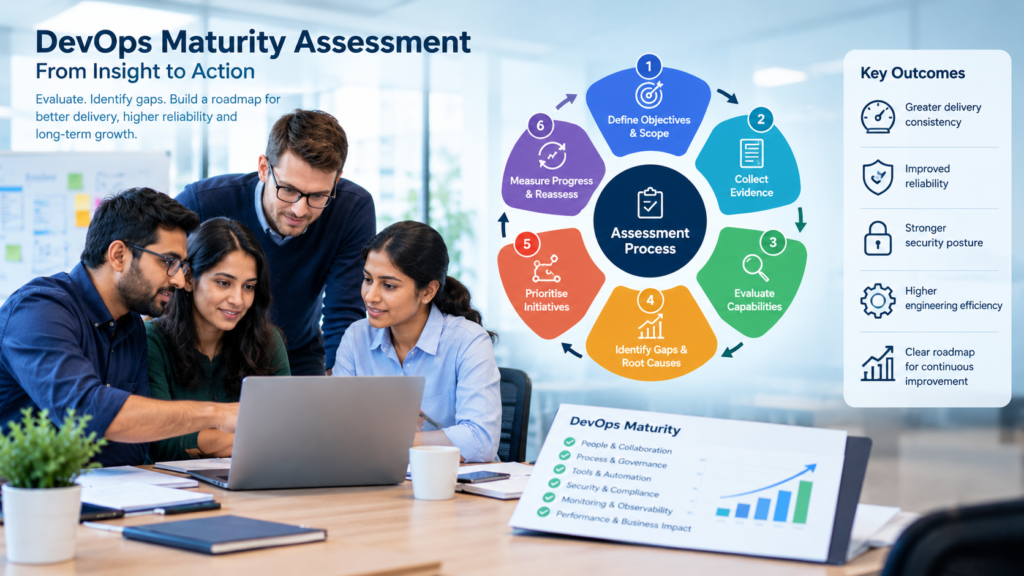
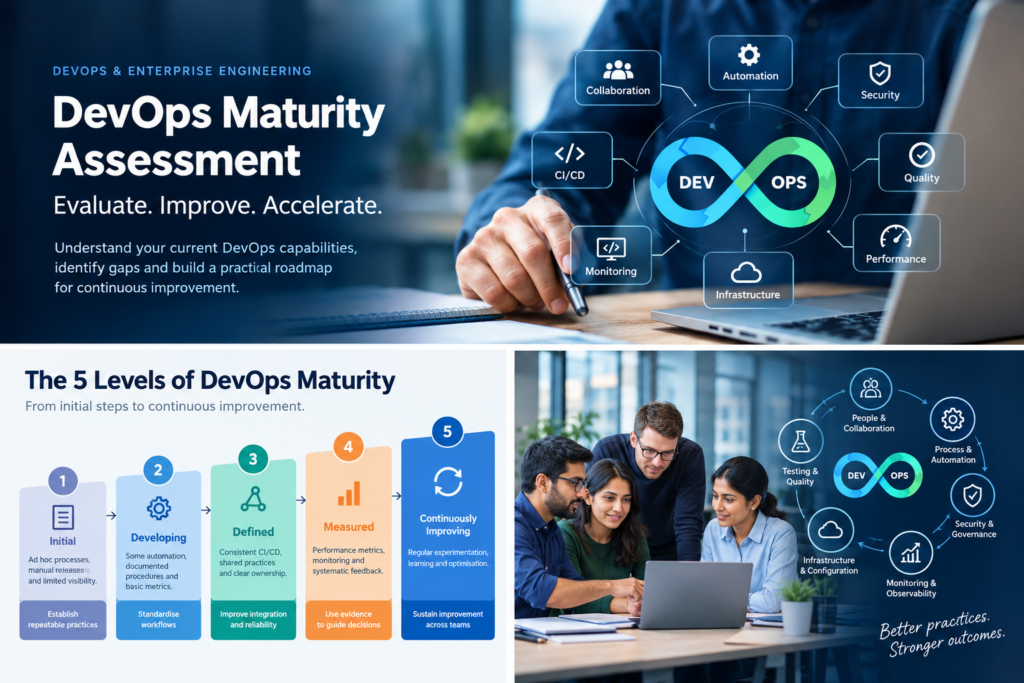
Every enterprise begins its Quality Engineering journey from a unique starting point. Sandhata applies the proprietary DevOps & SRE Maturity Compass to evaluate an organization’s current quality practices across 30 to 40 technical, operational, and cultural dimensions.
Level 1: Traditional Manual QA. Testing occurs manually at the end of development cycles. Tool sprawl is widespread, staging environments suffer from configuration drift, test data creation is manual, and software release lead times take months.
Level 2: Siloed Scripted Automation. Individual project teams build basic automated web scripts using legacy tools, but scripts fail frequently due to flakiness. API testing, performance validation, and security scanning remain separate manual steps.
Level 3: Integrated Continuous Quality Engineering. Unified test frameworks like Playwright run automatically inside CI/CD pipelines. Service Virtualization removes environment bottlenecks, synthetic test data ensures GDPR compliance, and automated quality gates enforce release standards.
Level 4: Autonomous Hyperautomated Quality. AI-driven hyperautomation via Sandhata’s ATOM2 platform optimizes test execution dynamically based on code change impact. Ephemeral environments validate feature branches on demand, self-healing scripts adapt to minor UI updates automatically, and production observability telemetry continuously guides quality priorities.
The Maturity Compass provides executive leadership with objective benchmark scores, uncovers hidden operational risks, and establishes a clear, phased roadmap for transformation.
Section 4: Bridging Hybrid Cloud and Legacy Mainframe Ecosystems
Established enterprises across banking, insurance, and telecommunications operate deeply interconnected hybrid architectures. A customer transaction initiated on a modern cloud mobile app frequently passes through API gateways and settles inside a decades-old IBM Z mainframe running COBOL and DB2.
Sandhata Technologies specializes in hybrid Quality Engineering Consulting. We design unified quality frameworks that validate customer journeys seamlessly across cloud microservices, middleware message queues, and legacy mainframe partitions simultaneously. By synchronizing automated testing and deterministic test data masking across both cloud and mainframe layers, Sandhata ensures complete end-to-end reliability.
Section 5: Enterprise Impact – Real-World Quality Engineering Case Studies
Case Study 1: Tier-1 Global Retail Bank Transforms QA into Continuous Quality Engineering
A leading global retail bank operated over one hundred agile development squads delivering digital banking features. Manual regression cycles required four weeks per release, legacy Selenium scripts suffered from a twenty-five percent flakiness rate, and environment booking conflicts delayed major digital launches.
Sandhata deployed a team of Quality Engineering Consultants to lead an enterprise-wide transformation. Sandhata conducted a Maturity Compass assessment, migrated brittle legacy scripts to a modular Playwright framework, deployed Service Virtualization for core mainframe ledgers, and integrated automated quality gates into multi-cloud CI/CD pipelines.
Regression testing execution time dropped by ninety percent, falling from four weeks down to under twenty-four hours. Test flakiness fell below one percent, defect escape rates to production dropped by eighty-two percent, and the bank accelerated from quarterly releases to weekly digital updates.
Case Study 2: Major European Telecom Provider Eliminates Release Bottlenecks
A multinational telecommunications provider struggled with recurring production incidents and slow software delivery across its customer billing and subscription platforms. Performance and security testing occurred manually right before launch, frequently uncovering critical defects that delayed releases by months.
Sandhata engineered a shift-left Quality Engineering strategy powered by automated API contract testing, Playwright UI automation, continuous performance benchmarks, and automated synthetic test data provisioning.
Software release lead time dropped by seventy-five percent, change failure rates fell below one percent, and automated compliance reporting saved over twelve thousand engineering hours annually.
Section 6: Essential Metrics for Quality Engineering Consulting Success
Measuring the strategic return on investment of a Quality Engineering transformation requires tracking objective metrics across speed, software quality, efficiency, and cost:
Defect Escape Rate: The percentage of software defects discovered in production environments relative to total defects caught during development and testing, targeted below 2 percent.
Lead Time for Quality: The total elapsed time required from code commit to complete automated quality validation, including functional, performance, and security checks.
Regression Execution Duration: The total time required to run complete enterprise regression suites, reduced from weeks to hours via parallel automation and risk-based selection.
Test Flakiness Rate: The percentage of automated test failures caused by script instability or environment timing glitches rather than genuine software bugs, kept below 1 percent.
Automated Test Coverage: The percentage of high-risk business workflows, API endpoints, and code paths validated by automated tests, targeted above 85 percent.
Cost of Quality Reduction: Measuring total savings achieved by eliminating manual regression hours, reducing late-stage bug rework, and consolidating redundant testing tool licenses.
Section 7: Frequently Asked Questions (FAQs)
FAQ 1: What is Quality Engineering Consulting?
Quality Engineering Consulting is a specialized advisory and technical implementation service that helps organizations transform traditional, manual Quality Assurance into a proactive, automated engineering discipline embedded across every stage of the software delivery lifecycle.
FAQ 2: How does Quality Engineering differ from traditional Quality Assurance (QA)?
Traditional Quality Assurance focuses on inspecting software and finding bugs manually after developers finish writing code. Quality Engineering builds quality directly into the software from day one through shift-left automation, continuous integration testing, performance engineering, and collaborative ownership.
FAQ 3: Why do enterprise organizations hire Quality Engineering Consultants?
Enterprises engage Quality Engineering Consultants to eliminate slow manual testing bottlenecks, modernize fragile legacy test scripts, integrate testing into CI/CD pipelines, virtualize unavailable mainframe or third-party dependencies, and satisfy strict regulatory compliance standards.
FAQ 4: What is Shift-Left Quality Engineering?
Shift-Left Quality Engineering moves testing, security scanning, and performance checks to the earliest stages of software development. By catching defects during requirements review and local code commits, organizations reduce bug remediation costs by up to one hundred times.
FAQ 5: How does Sandhata evaluate an organization’s quality engineering maturity?
Sandhata uses the proprietary DevOps & SRE Maturity Compass to audit quality practices across 30 to 40 technical and cultural dimensions, identifying testing bottlenecks, automation gaps, environment constraints, and compliance risks before creating a tailored transformation roadmap.
FAQ 6: What role does Service Virtualization play in Quality Engineering Consulting?
Service Virtualization simulates the behavior and data responses of unavailable third-party APIs, payment networks, and legacy mainframes. This eliminates environment waiting queues and allows automated test suites to run continuously anytime.
FAQ 7: Why do Quality Engineering Consultants recommend Playwright for web test automation?
Playwright delivers superior execution speed, built-in automatic waiting mechanisms that eliminate flaky tests, native multi-worker parallel execution, and cross-browser support across Chromium, Firefox, and WebKit with minimal maintenance overhead.
FAQ 8: How does Quality Engineering address GDPR compliance and test data privacy?
Quality Engineering replaces unmasked production database copies with automated data masking and synthetic test data generation, ensuring non-production environments operate with realistic test datasets containing zero real personal customer data.
FAQ 9: Can Quality Engineering be applied to legacy mainframes alongside modern cloud applications?
Yes. Sandhata specializes in hybrid stack quality engineering, connecting modern cloud CI/CD pipelines with legacy IBM mainframe transaction monitors and batch jobs to validate end-to-end business journeys across every system layer.
FAQ 10: What is Non-Functional Quality Engineering?
Non-Functional Quality Engineering embeds automated performance load testing, chaos resilience testing, security vulnerability scanning (DevSecOps), and WCAG accessibility checks directly into continuous delivery pipelines.
FAQ 11: How does Sandhata’s ATOM2 platform accelerate Quality Engineering transformations?
Sandhata’s ATOM2 platform provides low-code and no-code hyperautomation capabilities that streamline test orchestration, connect disparate tools, and empower non-technical business analysts to collaborate on automated quality validation.
FAQ 12: How does Quality Engineering support regulatory compliance in banking and healthcare?
By enforcing automated quality gates, Policy as Code checks, and tamper-proof audit logs for every test execution and security scan, Quality Engineering ensures continuous audit readiness for DORA, PRA rules, PCI-DSS, and HIPAA.
FAQ 13: What cultural changes are required when moving from QA to Quality Engineering?
Moving to Quality Engineering requires shifting from isolated testing silos to shared quality ownership, where developers, quality engineers, product owners, and operations teams collaborate continuously throughout the entire software lifecycle.
FAQ 14: What key metrics measure the return on investment of Quality Engineering Consulting?
Key metrics include Defect Escape Rate, Lead Time for Quality, Automated Test Coverage, Regression Execution Duration, Test Flakiness Rate, and Cost of Quality reduction.
FAQ 15: How long does a Quality Engineering Consulting engagement take with Sandhata?
Initial Maturity Compass assessments and strategic roadmaps require 2 to 4 weeks. Implementing core automation frameworks, pipeline quality gates, and pilot team transformations delivers measurable operational improvements within 8 to 12 weeks.
Strategic Recommendation and Next Steps
Relying on late-stage manual testing, isolated QA departments, brittle automation scripts, and unmasked test data slows down software delivery, inflates engineering budgets, and exposes enterprise organizations to costly production outages. To thrive in modern digital markets, technology leaders must elevate software quality into a continuous, automated engineering capability.
Quality Engineering Consulting provides a proven roadmap for enterprise transformation. By shifting testing left, modernizing frameworks with Playwright, virtualizing external dependencies, generating synthetic compliant test data, and embedding automated quality gates into CI/CD pipelines, organizations can release innovative software rapidly with complete confidence.
Sandhata Technologies brings over two decades of engineering excellence in quality transformation, DevOps integration, and legacy modernization across heavily regulated global industries.
Contact Sandhata’s Quality Engineering Consultants today to schedule your DevOps & SRE Maturity Compass Assessment and transform your enterprise software delivery capabilities.