Table of Contents
24/7 Lift Emergency Technician in Hyderabad | Rapid On-Site Elevator Repair
In the vibrant metropolitan landscape of Hyderabad, vertical transportation keeps high-rise IT hubs, gated residential communities, hospitals, and commercial malls moving smoothly. From the bustling corporate skyscrapers of HITEC City, Gachibowli, Knowledge City, and Financial District to high-density residential towers in Kukatpally, Kondapur, Miyapur, Kompally, and LB Nagar, thousands of elevators run around the clock.
However, when an elevator breaks down—whether due to a sudden power surge, mechanical brake jam, door sensor failure, or VVVF drive fault—the impact is immediate. An inoperative lift disrupts daily schedules, causes severe inconvenience, and creates safety risks for building occupants. In these critical moments, having a certified Lift Emergency Technician in Hyderabad on call is essential.
1. The Vital Role of an Emergency Elevator Technician
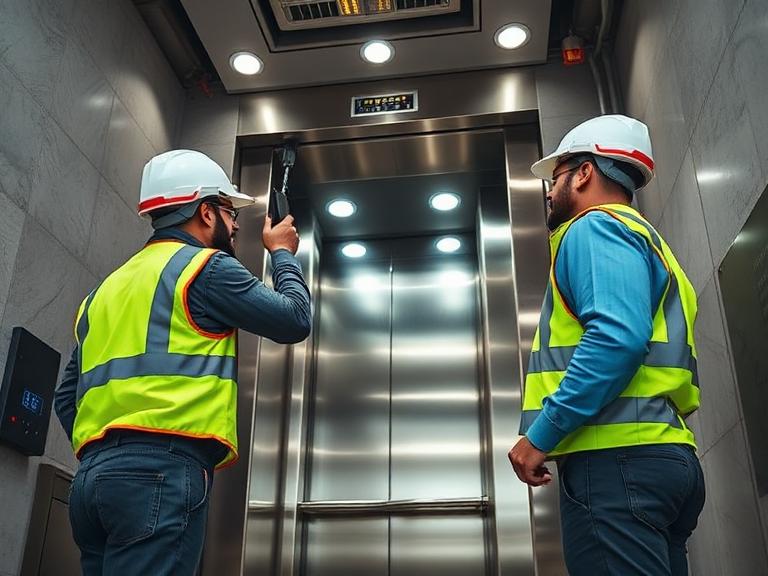
An emergency lift technician is a specialized electro-mechanical engineer trained to diagnose, troubleshoot, and resolve complex elevator failures under tight time constraints. Unlike routine monthly maintenance workers who perform basic cleaning and lubrication, an emergency technician is equipped to handle high-stress breakdown scenarios, complex electrical safety loop failures, and precision mechanical adjustments.
┌─────────────────────────────────────────────────────────────────────────────┐
│                 EMERGENCY TECHNICIAN RESPONSIBILITY MATRIX                  │
├──────────────────────────────────────┬──────────────────────────────────────┤
│        CRITICAL DIAGNOSTIC TASKS     │       MECHANICAL & SAFETY OVERHAUL   │
├──────────────────────────────────────┼──────────────────────────────────────┤
│ • Trace Blown Safety Chain Loops     │ • Adjust Mechanical Brake Pad Gap    │
│ • Clear VVVF Inverter Error Codes    │ • Reset Overspeed Governor Wedges    │
│ • Repair Door Operator Motor Drives  │ • Replace Burnt Main Contactors      │
│ • Diagnose ARD Inverter Board Failures│ • Re-align Landing Door Interlocks   │
│ • Calibrate Encoder Pulse Signals    │ • Execute Emergency Passenger Extraction│
└──────────────────────────────────────┴──────────────────────────────────────┘
When dispatched to a site, an emergency technician must quickly assess the fault, restore safety circuits, replace damaged components, and verify that the elevator meets all Telangana Lift Act safety parameters before reopening the car to the public.
2. Common Elevator Emergencies Requiring Immediate Technical Intervention
Elevators rely on a delicate balance of electrical, electronic, and mechanical systems. Understanding common breakdown modes helps facility managers describe issues clearly when calling an emergency technician:
1. Door Operator & Interlock Failures
The door mechanism accounts for over 60% of all elevator emergency service calls. Common door failures include:
- Light Curtain Obstructive Lockout: Infrared multi-beam light curtains become coated with dust or suffer sensor diode failure, causing doors to remain open or continuously cycle.
- Landing Door Interlock Misalignment: Mechanical pick-up rollers or microswitch contacts on landing doors become misaligned, breaking the safety circuit and keeping the car stationary.
- Worn Door Drive Belts: Snapped or loose door operator belts prevent car doors from opening smoothly at floor landings.
2. VVVF Drive & Control Panel Glitches
Modern elevators utilize Variable Voltage Variable Frequency (VVVF) inverters to control acceleration, deceleration, and leveling. High ambient machine room temperatures during Hyderabad summers ($>45^\circ\text{C}$) and grid voltage fluctuations frequently trigger drive errors:
- Overcurrent Trips (ERR02 / ERR03): Caused by shorted IGBT power modules, motor winding breakdowns, or dragging mechanical brakes.
- DC Bus Overvoltage (ERR04): Occurs when braking resistors fail to dissipate regenerative energy during deceleration.
- Undervoltage Faults (ERR05): Caused by grid voltage drops or degraded DC bus smoothing capacitors inside the drive.
3. Automatic Rescue Device (ARD) Failures
During severe weather or power cuts, an ARD should automatically drive the car to the nearest floor landing. When an ARD fails:
- SLA Battery Exhaustion: Sealed Lead-Acid batteries lose chemical capacity after 12 to 18 months, leaving the ARD unable to power the motor during a blackout.
- Inverter Board Burnout: Voltage surges during power restoration can destroy the ARD’s internal inverter cards, stranding passengers between floors.
4. Overspeed Governor & Safety Gear Wedge Lockouts
If an elevator car exceeds its rated speed—or experiences sudden power transients that trip governor solenoids—the mechanical overspeed governor engages heavy steel wedges that bite directly into the guide rails. Disengaging these wedges requires specialized hydraulic jack equipment operated by trained emergency mechanics.
3. Step-by-Step Emergency Technician Troubleshooting Protocol
When a certified lift emergency technician arrives on site in Hyderabad, they follow a strict, standardized diagnostic sequence:
1.Site Isolation, LOTO & Communication Setup:Prerequisite: Protect technicians and building occupants before taking measurements.
Place physical barrier guards and ‘Out of Service’ signs across all landing door entrances. Check for trapped occupants, establish clear intercom communication, and execute Lockout/Tagout (LOTO) protocols on the main 3-phase power isolator switch in the machine room.
2.Safety Chain Loop Continuity Verification:Electrical diagnostic phase.
Open the main elevator controller cabinet and use a True-RMS digital multimeter to test voltage across the safety circuit terminal strip. Trace continuity through emergency stop buttons, pit limit switches, buffer switches, governor switches, and door interlocks to locate the open circuit point.
3.VVVF Drive Diagnostics & Fault Log Analysis:Electronic parameter audit phase.
Connect a handheld digital programmer or view the controller LED display to retrieve stored fault codes. Examine historical error logs, check DC bus capacitor voltage levels, and verify encoder pulse signal integrity.
4.Door Operator & Brake System Re-calibration:Mechanical alignment phase.
Inspect mechanical brake shoe clearances using feeler gauges to ensure a gap of $0.2\text{ mm}$ to $0.3\text{ mm}$. Clean and align landing door header tracks, inspect pick-up rollers, replace worn microswitches, and adjust door drive belt tension.
5.Full-Load Test Run & CEIG Safety Audit:Safety verification phase.
Restore 3-phase power and perform manual inspection-mode test runs across the shaft. Verify floor leveling precision ($\pm 2\text{ mm}$), test emergency stop response, check ARD automatic switching, and confirm smooth, jolt-free travel before handing the lift back to building management.
4. Response Time SLAs Across Key Hyderabad Micro-Markets
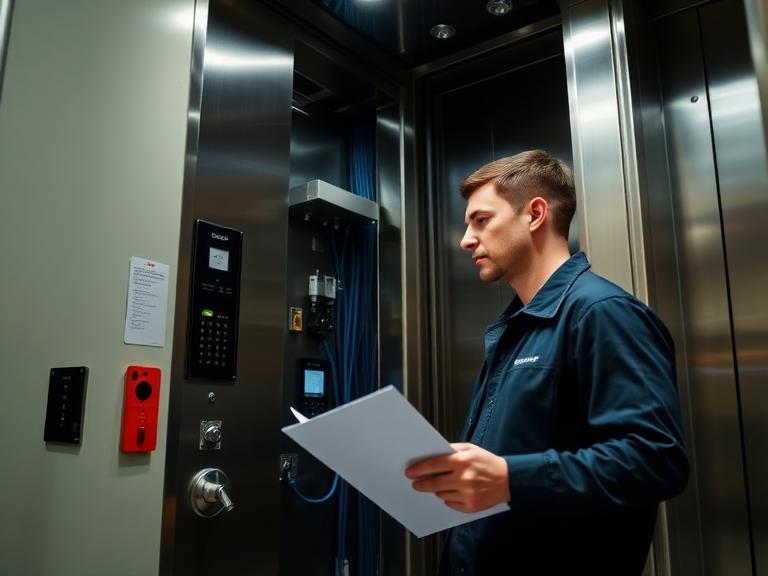
Emergency technician service networks strategically place mobile response units across Greater Hyderabad to ensure rapid on-site arrival:
Emergency Helpdesk Intake & Technician Dispatch
0 to 5 Minutes
The 24/7 central emergency desk receives the distress call, logs elevator error symptoms, identifies building access points, and dispatches the nearest mobile emergency technician unit equipped with diagnostic tools and spare parts.
Rapid Transit Across Hyderabad Corridors
5 to 25 Minutes
Technicians travel via mobile service vehicles along major transit corridors (e.g., PVNR Expressway, Outer Ring Road, NH65) to reach key commercial and residential hubs.
On-Site Arrival & Machine Room Diagnostics
25 to 40 Minutes
The technician arrives on site, connects with facility management, enters the machine room or MRL control station, and initiates safety circuit tracing.
Fault Resolution & Elevator Re-Commissioning
40 to 60 Minutes
Damaged relays, blown fuses, or faulty door microswitches are replaced, drive fault codes are cleared, and complete safety loop checks are executed to restore full elevator service.
5. Comparative Breakdown: Emergency Callout vs. Routine AMC Service
Building committees often wonder why a routine monthly maintenance visit differs from an emergency technician callout:
| Parameter | Routine Monthly AMC Service | Emergency Technician Callout |
| Primary Objective | Preventive lubrication, cleaning, and visual inspections. | Urgent fault identification, passenger extraction, and service restoration. |
| Response Time | Scheduled days in advance. | 30 to 45 Minute Emergency SLA. |
| Operating Hours | Standard business hours (9:00 AM – 6:00 PM). | 24 Hours a Day, 365 Days a Year. |
| Technical Equipment Carried | Basic hand tools, lubricants, cleaning cloths. | Multimeters, oscilloscopes, drive programmers, hydraulic jacks, door keys. |
| Scope of Work | Visual check of ropes, door shoes, and oil levels. | Advanced PCB troubleshooting, brake gap adjustments, safety wedge resets. |
| Target Resolution | Prevent future wear and tear. | Immediate resolution of acute operational failures. |
6. Price Matrix for Emergency Lift Technician Services in Hyderabad
Emergency service pricing varies based on the time of dispatch, complexity of technical labor, and spare parts required:
                  EMERGENCY REPAIR COST ALLOCATION
    ┌──────────────────────────────────────────────────────────────┐
    │  Certified Technician Field Labor & Diagnostics [35% - 40%]  │
    │  Genuine Replacement Parts (Relays, Sensors)   [30% - 35%]   │
    │  Emergency Dispatch & Travel (24/7 SLA)        [15% - 20%]   │
    │  Post-Repair Safety & Load Testing             [10% - 15%]   │
    └──────────────────────────────────────────────────────────────┘
Estimated Emergency Service Fee Schedule
| Emergency Technician Service | Typical Scope & Components Included | Estimated Cost Range (INR)* |
| Level 1: Emergency Diagnostic Callout | On-site arrival, safety chain tracing, fault log readouts, basic door clearing | ₹1,200 – ₹2,500 |
| Level 2: Door Mechanism & Interlock Repair | Landing door roller replacement, light curtain sensor repair, belt tensioning | ₹3,500 – ₹6,800 |
| Level 3: Mechanical Brake & Contactor Service | Main contactor coil replacement, mechanical brake shoe clearance adjustment | ₹5,500 – ₹11,500 |
| Level 4: Controller PCB & VVVF Field Repair | Control board relay swap, gate driver IC replacement, inverter parameter tuning | ₹9,500 – ₹18,500 |
| Level 5: Safety Wedge Reset & ARD Overhaul | Disengaging locked overspeed governor wedges, complete ARD battery bank replacement | ₹12,500 – ₹38,000 |
*Note: Prices depend on motor horsepower, drive brand, height of building, and required spare parts.
7. Regulatory Standards & CEIG Compliance in Telangana
Every emergency lift repair conducted in Telangana must adhere strictly to statutory safety codes:
- Telangana Lifts, Escalators, and Passenger Conveyors Act: Mandates that only certified technical personnel perform adjustments on elevator control panels, safety brakes, and governor mechanisms.
- Bureau of Indian Standards (IS 14665 & IS 17900): Governs design, testing, and maintenance standards for electric traction and gearless passenger elevators. Re-commissioned lifts must comply with these standards.
- CEIG Inspection Norms: The Chief Electrical Inspectorate to Government (CEIG) enforces annual safety inspections. Emergency technicians must ensure safety loops and door interlocks remain fully operational to pass CEIG audits.
8. Essential Guidelines for Building Management During Elevator Emergencies
When an elevator failure occurs, building administrators and security teams should follow these key rules:
Recommended Actions:
- DO isolate main 3-phase power at the breaker before entering machine rooms or attempting door unlock procedures.
- DO communicate calmly with any trapped occupants, assuring them that a professional technician is en route.
- DO keep machine room doors locked at all times to prevent unauthorized access by untrained personnel.
- DO maintain a dedicated logbook recording all emergency technician callouts, error codes, and replaced parts.
Actions to Avoid:
- DON’T allow general electricians or handymen to bypass safety chain relays or tamper with VVVF control panels.
- DON’T force open landing doors using makeshift levers, which can warp stainless steel door panels.
- DON’T restore electrical power while a technician is actively working inside the hoistway shaft or machine room.
Frequently Asked Questions (FAQs)
Q1: How quickly can a lift emergency technician arrive at my building in Hyderabad?
Answer: Emergency lift technicians operate from mobile response hubs across Greater Hyderabad, achieving an average arrival time of 30 to 45 minutes for key zones including HITEC City, Gachibowli, Madhapur, Kondapur, Kukatpally, Miyapur, Secunderabad, Begumpet, and LB Nagar.
Q2: What are the most common reasons to call an emergency lift technician in Hyderabad?
Answer: The most frequent emergency callouts involve door landing sensor failures, passenger entrapments due to power surges, VVVF drive fault trips (such as Overcurrent ERR02/03), broken door drive belts, burnt main contactor coils, safety gear lockouts, and ARD battery failure during grid power cuts.
Q3: What qualifications should a certified elevator emergency technician possess in Telangana?
Answer: A certified elevator technician must hold an ITI/Diploma in Electrical or Mechanical Engineering, possess specialized OEM training on traction and hydraulic control systems, be thoroughly versed in Bureau of Indian Standards safety protocols (IS 14665/17900), and adhere to guidelines enforced by the Chief Electrical Inspectorate to Government (CEIG) Telangana.
Q4: How much does an emergency lift technician callout cost in Hyderabad?
Answer: Emergency technician callout fees typically start between ₹1,200 and ₹2,500 for initial fault code diagnosis and basic door adjustment. Complex field repairs—such as replacing main contactors, adjusting brake coils, or repairing door operator motors—range from ₹3,500 to ₹14,500, excluding major electronic component replacement costs.
Q5: Why is my elevator door repeatedly opening and closing without moving?
Answer: This symptom is usually caused by an obstructed infrared door light curtain (safety sensor), misaligned door interlock microswitches, dirty landing door bottom sill grooves, or a worn door operator drive belt preventing the control board from receiving the “door fully closed” signal.
Q6: Can a general building electrician handle elevator emergency repairs?
Answer: No. General electricians lack specialized knowledge of high-voltage elevator safety chains, VVVF drive parameters, mechanical brake clearances, overspeed governor mechanics, and encoder feedback loops. Attempting uncertified repairs on elevator panels poses severe safety hazards and violates Telangana lift safety laws.
Q7: What should building management do while waiting for the emergency lift technician to arrive?
Answer: Building management should immediately turn off the main 3-phase circuit isolator in the machine room, place “Out of Service” barrier signs on all floor landings, communicate reassuringly with any trapped passengers via intercom, and ensure clear, unobstructed access to the machine room for the technician.
Q8: How do technicians resolve an overspeed governor safety wedge trip?
Answer: When an overspeed governor trips, mechanical wedges bite tightly into the steel guide rails, locking the car in place. Technicians must first verify hoistway cable integrity, isolate power, attach specialized hydraulic lifting jacks or heavy chain blocks to relieve car weight, manually reset the governor mechanical linkage, and carefully disengage the safety wedges.
Q9: Why does an elevator drop slightly below floor level before opening doors?
Answer: Misleveling occurs when floor magnetic leveling switches are misaligned, mechanical brake shoes are worn or slipping, hydraulic oil temperatures fluctuate, or encoder pulse counts on the VVVF drive have drifted out of calibration.
Q10: Are emergency lift technicians available 24/7 on weekends and festival holidays in Hyderabad?
Answer: Yes. Professional emergency elevator response agencies maintain 24/7/365 operational shifts—including midnight hours, Sundays, and major festival holidays across all zones in Greater Hyderabad and Secunderabad.
Q11: What is a safety chain circuit in an elevator controller?
Answer: The safety chain circuit is a series electrical loop connecting all safety microswitches in the elevator—including emergency stop buttons, pit buffer switches, overspeed governor switches, top/bottom limit switches, and landing door interlocks. If any single switch opens, the main controller instantly cuts power to the motor and drops the brakes.
Q12: How do emergency technicians fix Automatic Rescue Device (ARD) glitches?
Answer: Technicians test internal SMF battery voltage under load, inspect high-voltage battery fuses, replace burnt inverter MOSFET cards, clean relay contacts, and recalibrate main supply sensing transformers to ensure smooth automated switching during grid outages.
Q13: What diagnostic tools do emergency elevator technicians carry in their service kits?
Answer: Emergency technicians carry True-RMS digital multimeters, digital storage oscilloscopes, handheld parameter programmers (for Monarch, Yaskawa, Fuji drives), insulation resistance testers (Megger), door key sets, hydraulic jack sets, laser alignment tools, and mechanical brake clearance gauges.
Q14: Why does an elevator make a loud grinding noise during movement?
Answer: Grinding noises typically stem from worn guide shoe gibs scraping dry guide rails, unlubricated counterweight rollers, worn motor bearings, misaligned gearbox worm gears, or misaligned mechanical brake shoes rubbing against the brake drum.
Q15: How can gated residential communities reduce frequent emergency technician callouts?
Answer: RWAs can reduce breakdown frequency by enforcing monthly comprehensive maintenance schedules, replacing aging ARD batteries every 2 years, installing surge protection devices (SPD) on main panels, maintaining clean machine room ventilation below $35^\circ\text{C}$, and cleaning landing door sill tracks regularly.
Conclusion: Reliable 24/7 Elevator Response Across Hyderabad
A sudden elevator breakdown requires rapid, expert technical intervention to restore vertical transit safety and convenience. Partnering with a professional Lift Emergency Technician in Hyderabad guarantees rapid 30-to-45-minute on-site arrival, expert electro-mechanical diagnostics, genuine spare parts installation, and full compliance with Telangana lift safety standards.