Table of Contents
Enterprise DevOps Consulting: A Guide for Businesses
Modern enterprises rely on software to deliver customer experiences, support business operations and respond to changing market conditions. As applications become more interconnected and technology environments grow increasingly complex, delivering software reliably requires more than development tools or isolated automation initiatives.
Large organisations often work with multiple development teams, legacy applications, cloud platforms, security requirements and operational processes. These dependencies can make software releases difficult to coordinate. Teams may use different tools, follow inconsistent deployment practices or struggle to identify the causes of production incidents.
Enterprise DevOps consulting helps organisations examine these challenges and develop a structured approach to improving software delivery. It brings together development, operations, quality engineering, security and business stakeholders to establish more consistent processes across the software lifecycle.
Rather than treating DevOps as the installation of a particular tool, an effective consulting engagement considers the organisation’s existing capabilities, business objectives, technical architecture and operational constraints.
For enterprise technology leaders, the central question is not simply how to automate more tasks. It is how to create a sustainable delivery model that supports collaboration, quality, security and operational reliability as the organisation grows.
This guide explains what enterprise DevOps consulting involves, which challenges it addresses, how consulting engagements typically work and what organisations should evaluate before selecting a consulting partner.
What Is Enterprise DevOps Consulting?
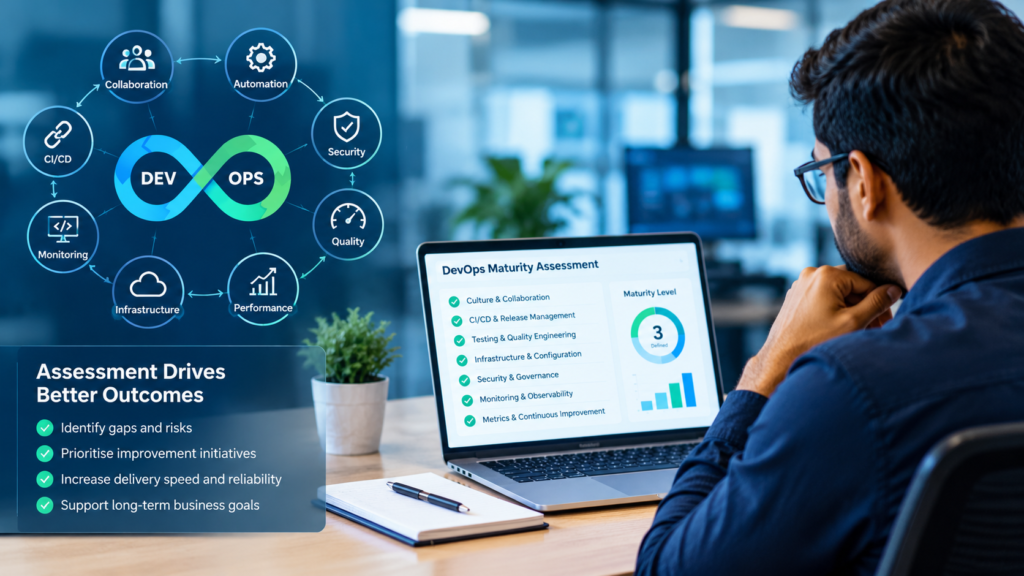
Enterprise DevOps consulting is a professional service that helps large or complex organisations assess, design, implement and improve practices connecting software development and IT operations.
The objective is to help teams deliver software through repeatable, measurable and appropriately controlled processes. Depending on organisational needs, an engagement may cover:
- DevOps strategy and maturity assessment.
- Continuous integration and continuous delivery (CI/CD).
- Build, test and deployment automation.
- Cloud and infrastructure automation.
- Release management and environment consistency.
- DevSecOps and security integration.
- Quality engineering and automated testing.
- Monitoring, observability and incident management.
- Site Reliability Engineering (SRE) practices.
- Team collaboration, governance and performance measurement.
The scope varies according to the organisation’s architecture, regulatory obligations, team structure and business priorities.
For example, a financial services enterprise may prioritise controlled releases, auditability and security checks. A digital commerce organisation may focus on deployment consistency, performance testing and recovery procedures. A company modernising legacy systems may need to coordinate established applications with newer cloud-native services.
In each case, consulting should connect technical changes with clearly defined business and operational outcomes.
Why Enterprises Need a Different DevOps Approach
DevOps principles can benefit organisations of different sizes, but enterprise environments introduce additional coordination and governance requirements.
1. Complex technology environments
Large organisations may operate cloud platforms, on-premises infrastructure, legacy systems, containerised applications and third-party services simultaneously. Standardising delivery across these environments requires an understanding of their dependencies and constraints.
2. Multiple development teams
Different teams may use separate repositories, testing frameworks, branching strategies and release procedures. Without agreed standards, maintaining consistency becomes difficult.
3. Lengthy release processes
Manual approvals, handovers, environment preparation and repetitive testing can delay releases. Consulting helps identify which activities can be automated and which controls need to remain in place.
4. Security and compliance requirements
Enterprises may need evidence of approvals, traceable changes, access controls and repeatable security checks. DevOps practices should incorporate these requirements into delivery workflows rather than treat security as a separate final-stage activity.
5. Operational reliability
More frequent releases must be supported by suitable monitoring, alerting, incident response and recovery practices. Faster deployment without operational readiness can increase risk instead of reducing it.
6. Difficulty measuring progress
Counting deployments alone does not reveal whether delivery is improving. Organisations need a balanced view of speed, stability, quality, recovery and customer impact.
Enterprise DevOps consulting helps bring these concerns into a coordinated improvement plan.
Core Services Included in Enterprise DevOps Consulting
The exact service portfolio depends on the consulting provider and the organisation’s requirements. The following capabilities commonly form part of an enterprise DevOps engagement.
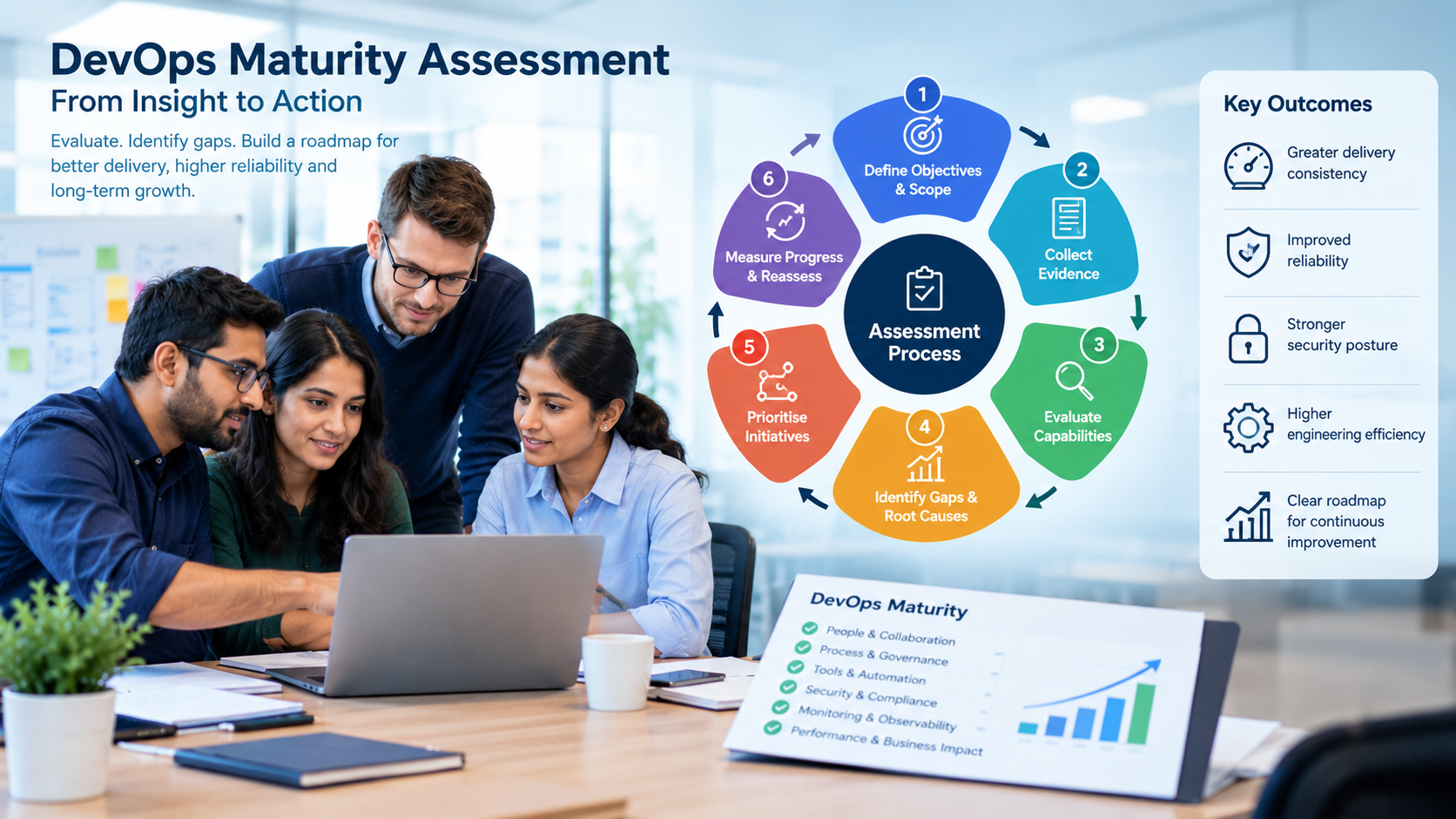
1. DevOps strategy and maturity assessment
A maturity assessment establishes a baseline of current practices before major changes begin.
Consultants may review team responsibilities, source control, build processes, automated testing, deployment procedures, infrastructure management, security controls and operational feedback.
The assessment should identify both strengths and limitations. It can then prioritise improvement opportunities according to business value, technical risk, implementation effort and organisational readiness.
A practical strategy defines a target operating model, milestones, ownership and measures of progress. This helps prevent transformation programmes from becoming collections of unrelated tool implementations.
2. CI/CD pipeline design and optimisation
Continuous integration supports the frequent integration and validation of code changes. Continuous delivery prepares software for reliable release through repeatable processes.
Enterprise CI/CD consulting may include:
- Reviewing existing build and deployment pipelines.
- Standardising pipeline templates where appropriate.
- Automating compilation, testing and packaging.
- Introducing consistent environment configuration.
- Managing deployment permissions and approvals.
- Improving release traceability and rollback preparation.
- Reducing duplicated pipeline maintenance.
The aim is to make delivery processes more predictable while preserving the controls required for the organisation’s risk profile.
Not every application needs an identical pipeline. Shared standards can coexist with application-specific testing, deployment and approval requirements.
3. DevOps automation
Automation can reduce repetitive work, improve consistency and make processes easier to audit. However, automating a poorly designed process may simply reproduce its weaknesses more quickly.
A consulting engagement should first identify activities that are suitable for automation. These may include environment provisioning, test execution, configuration validation, deployment steps and routine release checks.
Automation priorities should consider how often a task occurs, the consequences of human error, the effort required to automate it and the cost of maintaining the resulting solution.
4. Cloud and infrastructure automation
Enterprises frequently need consistent infrastructure across development, testing, staging and production environments.
Infrastructure as Code (IaC) enables infrastructure definitions to be maintained in version control and applied through repeatable processes. Depending on the environment, consultants may also assess configuration management, container platforms, secrets handling and environment provisioning.
The objective is to reduce configuration drift, improve reproducibility and establish clearer change-management practices.
Cloud adoption does not automatically produce a mature DevOps environment. Architecture, governance, monitoring, cost management and operational ownership still require attention.
5. DevSecOps integration
DevSecOps incorporates security considerations throughout software development and delivery.
Relevant practices may include dependency checks, static analysis, container-image scanning, secrets detection, infrastructure configuration checks and security testing at appropriate pipeline stages.
A mature approach also considers access controls, exception management, vulnerability remediation and audit evidence.
Security controls should be proportionate to the application’s risks. Excessive or poorly configured checks can create bottlenecks, while insufficient checks can allow preventable issues to progress.
Enterprise DevOps consultants can help teams define controls that support secure delivery without relying exclusively on a final pre-release review.
6. Quality engineering and test automation
Automated testing is an important part of reliable software delivery. Yet test automation is most effective when it is supported by a clear quality strategy.
Consultants may examine unit, integration, API, user-interface, regression, performance and security testing. They can help determine which tests belong at different pipeline stages and how test results should influence release decisions.
Other considerations include test data management, flaky tests, test-environment stability, coverage gaps and maintenance effort.
The goal is not to automate every possible test. It is to create a risk-based testing approach that provides useful feedback at the right point in the development lifecycle.
7. Monitoring, observability and SRE
DevOps does not end when a deployment succeeds. Enterprises need to understand how applications behave under real operating conditions.
Monitoring and observability practices can help teams investigate latency, errors, resource utilisation, dependencies and other signals relevant to application health.
Site Reliability Engineering introduces practices such as service-level indicators, service-level objectives, error budgets and structured incident reviews where appropriate.
Consulting can help define service ownership, alert thresholds, escalation procedures and post-incident learning. The appropriate model depends on service criticality, team capacity and existing operational responsibilities.
8. Release management and governance
Large organisations often coordinate releases across multiple applications, shared services and business units. Governance needs to provide appropriate control without introducing unnecessary delays.
Consultants may review release calendars, change approvals, deployment windows, separation of duties, evidence collection and rollback procedures.
Standardised processes can improve visibility, but governance should remain proportionate. A low-risk change may need a different control path from a change affecting a critical business service.
How Enterprise DevOps Consulting Works
A successful engagement normally follows a sequence of discovery, planning, implementation and continuous improvement. The precise stages depend on the scope and delivery model.
Step 1: Understand business objectives
The first step is to understand why the organisation is considering DevOps improvements.
Possible objectives include improving release predictability, reducing manual effort, strengthening security, improving incident recovery or standardising delivery across teams.
These objectives should be specific enough to guide prioritisation and evaluation.
Step 2: Assess the current environment
The assessment may cover application architecture, repositories, pipeline tooling, infrastructure, testing, security, release controls, monitoring and team responsibilities.
Interviews and workshops can reveal operational difficulties that are not obvious from technical documentation alone.
The outcome should be a documented baseline, including constraints and dependencies.
Step 3: Identify and prioritise gaps
Not all weaknesses should be addressed at once. The consulting team should distinguish between high-risk issues, high-value improvements and longer-term transformation opportunities.
A useful prioritisation model considers expected value, implementation effort, technical dependencies and risk reduction.
Step 4: Define the target operating model
The target model establishes how teams will build, test, release and operate software.
It may include pipeline standards, platform responsibilities, security controls, shared tooling, service ownership, governance and measurement practices.
A target model should be realistic for the organisation’s skills, architecture and operating requirements.
Step 5: Implement a focused pilot
A pilot can test the proposed approach with a suitable application or team before broader adoption.
The selected pilot should be representative enough to provide useful learning, but manageable enough to limit risk. Success criteria should be agreed in advance.
Step 6: Scale through repeatable practices
After evaluating the pilot, the organisation can refine its approach and expand it to other teams.
Reusable pipeline components, documentation, training and platform support can help adoption. Teams should retain flexibility where applications have legitimate differences.
Step 7: Measure, review and improve
DevOps improvement is an ongoing activity. Teams should review delivery and reliability metrics, identify emerging constraints and adjust practices based on evidence.
Periodic assessments can help determine whether the organisation is progressing towards its goals and where further investment may be useful.
Choosing the Right Enterprise DevOps Consulting Partner
Selecting a consulting partner requires more than comparing tool expertise. Enterprises should evaluate how well a provider can work with their technical environment, business priorities and organisational constraints.
Relevant enterprise experience
Ask whether the provider understands multi-team delivery, legacy applications, hybrid infrastructure, complex dependencies and enterprise governance.
Experience should be relevant to the organisation’s environment rather than presented as a generic claim.
Strategic and technical capability
A suitable partner should be able to discuss both operating-model decisions and practical implementation. Strategy without execution may leave teams with a roadmap they cannot use; tool implementation without strategy can produce fragmented results.
Security and compliance awareness
The provider should understand how to incorporate security, access management, traceability and change controls into the delivery lifecycle.
For regulated organisations, clarify how proposed practices will align with internal policies and applicable requirements.
Knowledge transfer
The long-term objective should be to build sustainable organisational capability. Ask how the engagement will document decisions, train teams and transfer ownership of pipelines, platforms and operational processes.
Measurement and transparency
Look for a clear explanation of the baseline, proposed outcomes, measurement methods, dependencies and limitations.
Be cautious of guaranteed percentage improvements without an assessment of the starting environment.
Collaboration and communication
Enterprise transformation involves developers, operations engineers, security specialists, quality teams and business stakeholders. The consulting partner should be able to communicate technical trade-offs clearly and work with existing teams.
Measuring the Value of Enterprise DevOps Consulting
A useful measurement framework combines delivery performance, stability, quality and operational outcomes.
Deployment frequency
This measures how often an application or service is deployed. The appropriate target depends on the application, business needs and risk profile.
Lead time for changes
Lead time measures the time between a code change being committed and that change reaching the relevant production environment. Definitions should be consistent when comparing teams or services.
Change failure rate
This metric examines the proportion of deployments that result in a failure requiring intervention, rollback or another defined remediation action. Organisations should establish a consistent definition before comparing results.
Failed deployment recovery time
This measures how long it takes to recover from a deployment-related failure. It can help reveal weaknesses in rollback procedures, diagnostics and incident response.
These four measures are commonly associated with DORA’s software delivery performance research. They should be interpreted together rather than used as isolated targets.
Other useful measures may include:
- Automated test reliability and execution time.
- Pipeline failure frequency and causes.
- Vulnerability remediation time.
- Infrastructure provisioning time.
- Production incident frequency and impact.
- Change approval and release waiting time.
- Developer effort spent on repetitive operational work.
- Service-level objective performance.
Metrics should support learning rather than encourage teams to optimise numbers at the expense of software quality or customer outcomes.
Common Enterprise DevOps Consulting Challenges
Treating tools as the entire solution
Purchasing a new platform does not automatically improve collaboration or delivery. Tool choices should follow an assessment of workflows, architecture and operating requirements.
Automating inefficient processes
If a release process contains unnecessary steps or unclear ownership, automation alone may not solve the underlying problem. Process design should precede or accompany automation.
Ignoring organisational culture
DevOps requires collaboration and shared responsibility. Teams may need clearer ownership, new communication practices and support from leadership to make changes sustainable.
Creating too many standards
Consistency is useful, but excessive standardisation can prevent teams from addressing legitimate application-specific needs. Define common guardrails while allowing justified flexibility.
Measuring activity instead of outcomes
Counting pipelines, tools or training sessions does not establish business value. Measurement should connect technical changes to delivery reliability, quality and operational performance.
Expanding before validating
Rolling out an untested approach across every team can multiply problems. Pilot programmes and structured feedback help organisations refine practices before scaling.
The Role of Sandhata Technologies in Enterprise DevOps Improvement
Sandhata Technologies works in enterprise engineering and technology services, including DevOps and cloud-related capabilities, quality engineering, Site Reliability Engineering, service virtualisation, system integration and legacy modernisation.
These areas can be relevant to organisations seeking a more coordinated approach to software delivery. For example, CI/CD improvements may need to be considered alongside automated testing, service dependencies, operational monitoring and the constraints of existing applications.
The most appropriate engagement depends on the enterprise’s specific objectives and current environment. Before selecting services, organisations should establish the problems they need to solve, the systems involved, the controls they must maintain and the outcomes they intend to measure.
For organisations evaluating Enterprise DevOps Consulting, Sandhata Technologies can be considered as a potential discussion partner for assessing relevant enterprise engineering needs and identifying a suitable improvement approach. The scope, deliverables and expected outcomes should be confirmed directly for each engagement.
Frequently Asked Questions About Enterprise DevOps Consulting
1. What is enterprise DevOps consulting?
Enterprise DevOps consulting helps organisations improve software development, testing, deployment and operations through better processes, automation, collaboration and measurement.
2. Why do large organisations need DevOps consulting?
Large organisations often have multiple teams, complex applications, legacy systems and governance requirements. Consulting can help identify delivery bottlenecks and coordinate improvements across these environments.
3. What services are included in enterprise DevOps consulting?
Services may include maturity assessments, CI/CD optimisation, infrastructure automation, DevSecOps, test automation, cloud engineering, release management, monitoring and SRE practices.
4. How is enterprise DevOps different from traditional IT operations?
Enterprise DevOps promotes closer collaboration between development and operations, with greater use of repeatable automation and feedback. It does not remove the need for operational controls or clear accountability.
5. What is a DevOps maturity assessment?
It is a structured review of an organisation’s current delivery practices, automation, testing, security, collaboration and operational capabilities. The results help establish improvement priorities.
6. How long does an enterprise DevOps consulting engagement take?
The duration depends on the scope, application complexity, number of teams, existing tooling and desired deliverables. A focused assessment may be shorter than a multi-team transformation programme.
7. Can DevOps consulting help improve CI/CD pipelines?
Yes. A consulting engagement can identify pipeline bottlenecks, duplicated steps, unreliable tests and manual deployment activities, then recommend or implement appropriate improvements.
8. Is enterprise DevOps consulting suitable for legacy applications?
Yes, provided the approach accounts for the application’s architecture, dependencies and operational constraints. Legacy systems may require tailored testing, release procedures and integration strategies.
9. What is the difference between DevOps and DevSecOps?
DevOps connects development and operations to improve software delivery and operational feedback. DevSecOps incorporates security practices and controls throughout that lifecycle.
10. How does test automation support enterprise DevOps?
Automated tests provide repeatable feedback on software changes. When designed and maintained appropriately, they can help teams identify defects earlier and make release decisions with better evidence.
11. What is the role of Site Reliability Engineering in DevOps?
SRE applies engineering practices to service reliability. It can include service-level objectives, monitoring, incident response, error budgets and structured reviews of operational failures.
12. Which metrics should enterprises track?
Useful measures include deployment frequency, lead time for changes, change failure rate, recovery time, test reliability, pipeline failures and service-level objective performance. Metrics should be interpreted in context.
13. Does enterprise DevOps consulting require moving to the cloud?
No. DevOps practices can support cloud, on-premises and hybrid environments. Infrastructure decisions should be based on application needs, operational requirements and business priorities.
14. How should an enterprise choose a DevOps consulting company?
Evaluate relevant experience, technical capability, security awareness, communication, knowledge transfer, measurement methods and the provider’s ability to work within existing constraints.
15. Can DevOps consulting improve software release reliability?
It can help organisations strengthen testing, deployment consistency, monitoring and recovery practices. Actual results depend on the initial environment, implementation quality and continued adoption.
16. What is infrastructure as Code?
Infrastructure as Code is the practice of defining and managing infrastructure through version-controlled configuration or code. It supports repeatable provisioning, review and change management.
17. How does DevOps consulting support compliance?
Consultants can help integrate access controls, approvals, traceability, security checks and evidence collection into delivery workflows. Requirements must be validated against the organisation’s applicable policies and regulations.
18. Should an enterprise automate every release activity?
No. Automation is most valuable for suitable repeatable tasks. Some changes may require human review, risk assessment or explicit approval, depending on their impact and governance requirements.
19. What should an organisation prepare before engaging a DevOps consultant?
Useful preparation includes business objectives, application inventories, current delivery workflows, existing tool information, known bottlenecks, security requirements and baseline performance data where available.
20. How can an enterprise sustain DevOps improvements after consulting ends?
Sustainability depends on clear ownership, documented standards, team training, maintainable automation, useful metrics and regular reviews. Knowledge transfer should be part of the engagement plan.
Conclusion
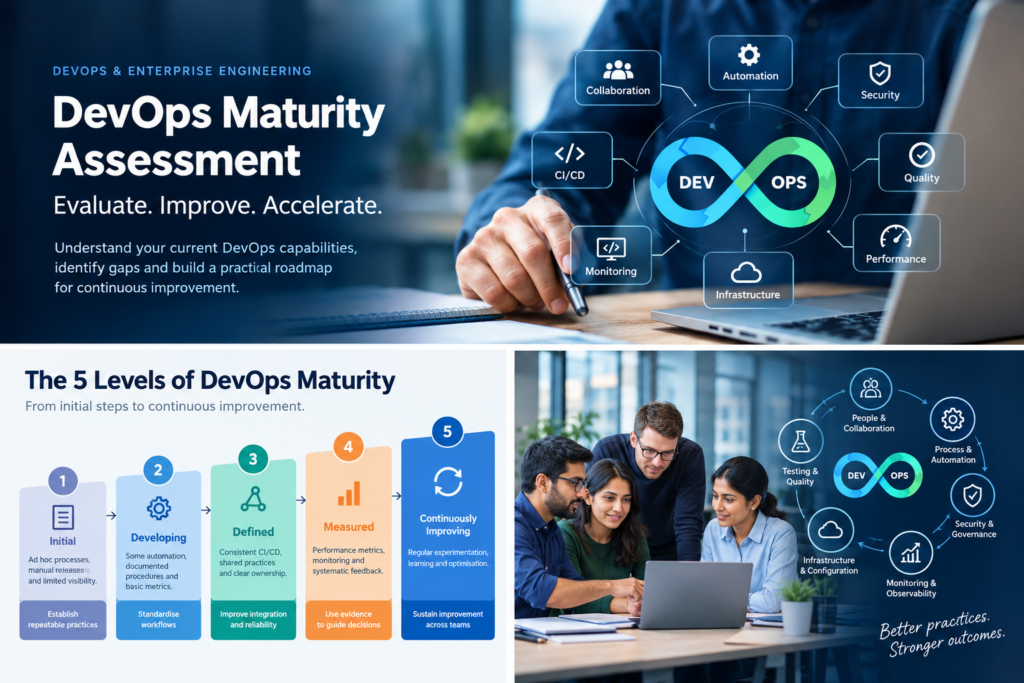
Enterprise DevOps consulting provides a structured way for organisations to improve software delivery across complex technical and organisational environments. The strongest approach combines strategy with practical engineering, linking CI/CD, automation, quality, security and operational reliability to measurable objectives.
Enterprises should begin by understanding their current capabilities, prioritising the most important constraints and defining realistic outcomes. Focused pilots, consistent measurement and effective knowledge transfer can help make improvements sustainable as more teams adopt the approach.
Rather than pursuing automation for its own sake, organisations should aim to build a delivery model that is repeatable, secure, observable and suited to their business needs.
For enterprises exploring Enterprise DevOps Consulting, the first step is to identify the current delivery challenges and assess which improvements would create the greatest value within their operational and governance constraints.