Table of Contents
Cloud DevOps Engineering Services | Enterprise Cloud Migration & Automation | Sandhata
Enterprise organizations are accelerating cloud adoption to increase business agility, innovate rapidly, and improve operational scalability. However, migrating legacy enterprise workloads to cloud environments without modern DevOps engineering practices frequently creates complex operational bottlenecks, unexpected cloud costs, and heightened compliance risks.
Traditional enterprise infrastructure management—characterized by manual server configuration, ticket-based provisioning requests, and disconnected security reviews—cannot support the operational scale of public, private, and hybrid cloud platforms.
Cloud DevOps Engineering Services bridge this gap. By combining cloud-native architecture design, Infrastructure as Code, automated deployment pipelines, and integrated security controls, Cloud DevOps transforms cloud environments into secure, high-speed delivery engines.
This guide explores the technical strategies, core architectural pillars, and operational practices of Sandhata Technologies’ Cloud DevOps Engineering Services, demonstrating how enterprise organizations in banking, telecommunications, and financial services achieve continuous agility with complete regulatory compliance.
Section 1: The Enterprise Cloud Transformation Challenge
While the benefits of enterprise cloud computing are well established, large-scale organizations encounter significant technical barriers during execution.
1.1 Lift-and-Shift Fallacies and Configuration Drift
Many enterprise cloud initiatives rely on simple lift-and-shift migrations, transferring legacy virtual machine architectures directly into cloud environments without modern automation. This approach replicates existing operational bottlenecks. Manual server modifications introduce severe configuration drift across development, staging, and production environments, resulting in deployment failures and unpredictable system behavior.
1.2 Multi-Cloud Complexity and Fragmentation
Enterprises frequently operate across multiple cloud providers—such as Amazon Web Services, Microsoft Azure, and Google Cloud Platform—alongside on-premises data centers and legacy mainframes. Managing disparate cloud management consoles, varied security configurations, and divergent toolchains creates operational silos that slow release velocity and increase overhead.
1.3 Security as a Downstream Bottleneck
In traditional IT environments, security reviews occur at the end of the development lifecycle. When applied to high-velocity cloud deployments, manual security reviews create severe release delays. Conversely, bypassing security controls to meet deadlines exposes the organization to severe cloud misconfigurations, data leaks, and regulatory non-compliance.
1.4 Uncontrolled Cloud Infrastructure Expenses
Without automated governance and dynamic resource lifecycle management, enterprise cloud costs escalate rapidly. Unmonitored staging environments, over-provisioned cloud compute resources, and abandoned storage volumes drain operational budgets without adding business value.
Section 2: Core Engineering Pillars of Sandhata’s Cloud DevOps Services
Sandhata Technologies delivers specialized Cloud DevOps Engineering Services designed to overcome these enterprise challenges. Sandhata combines modern software engineering practices with cloud-native architectures to establish scalable, secure, and fully automated cloud ecosystems.
2.1 Pillar 1: Declarative Infrastructure as Code and Immutable Infrastructure
Sandhata replaces manual cloud resource provisioning with declarative Infrastructure as Code. Every network interface, virtual network, storage bucket, database instance, and security group is defined as code, stored within version control systems, and deployed through automated pipelines.
This approach guarantees that cloud environments are completely repeatable, audit-ready, and free from manual configuration drift. Sandhata promotes immutable infrastructure models, where cloud environments are never updated directly in place. Instead, modified configurations generate new, clean infrastructure builds while legacy instances terminate automatically, ensuring complete environmental integrity.
2.2 Pillar 2: High-Velocity Multi-Cloud CI/CD Pipelines
Sandhata constructs robust, multi-cloud continuous integration and continuous deployment pipelines designed for complex enterprise architectures. These pipelines automate code validation, container building, security scanning, dynamic test execution, and progressive production deployments.
By building standardized pipeline templates across AWS, Azure, and GCP, Sandhata enables software engineering teams to deploy microservices, APIs, and cloud-native workloads across diverse cloud destinations using unified operational interfaces.
2.3 Pillar 3: DevSecOps and Policy as Code Governance
Sandhata embeds automated security controls directly into cloud delivery pipelines, shifting security left in the software lifecycle. Static analysis, dependency vulnerability scanning, container security audits, and secret detection tools execute automatically during every code build.
Furthermore, Sandhata implements Policy as Code governance frameworks. Automated evaluation tools check infrastructure code against strict regulatory standards (such as DORA, PRA regulations, and PCI-DSS) before cloud resources are provisioned. Non-compliant configurations are automatically blocked in the pipeline, eliminating cloud security risks before deployment.
2.4 Pillar 4: Ephemeral Environments and Dynamic On-Demand Testing
Fixed, long-lived staging environments create continuous scheduling conflicts between development teams and consume unnecessary cloud budgets during idle hours. Sandhata implements automated ephemeral environments.
When a software engineer submits a new feature or pull request, the CI/CD pipeline automatically provisions an isolated, temporary cloud testing environment using Infrastructure as Code. Automated test suites execute, and once testing completes, the temporary environment dismantles automatically. This approach accelerates testing cycles, isolates code changes, and dramatically reduces cloud compute expenditure.
2.5 Pillar 5: Containerization and Cloud-Native Orchestration
Sandhata modernizes enterprise application architectures by leveraging containerization and cloud-native orchestration platforms such as Kubernetes, Amazon Elastic Kubernetes Service (EKS), Azure Kubernetes Service (AKS), and Google Kubernetes Engine (GKE).
By packaging application workloads with their explicit dependencies into lightweight containers, Sandhata ensures absolute consistency across development workstations, cloud staging environments, and production clusters. Container orchestration provides automated resource scaling, dynamic load balancing, and self-healing application management.
2.6 Pillar 6: Hybrid Cloud and Legacy Mainframe Modernization
Enterprise cloud implementations rarely exist in isolation; they must interact seamlessly with core legacy backends. Sandhata specializes in integrating modern cloud DevOps pipelines with core legacy mainframes.
Utilizing API management frameworks, automated boundary testing, and Service Virtualization, Sandhata simulates legacy mainframe dependencies during cloud development cycles. This decoupling enables cloud engineering teams to build and test high-velocity frontend microservices without causing resource strain or scheduling conflicts on core backend systems.
Section 3: The Sandhata DevOps & SRE Maturity Compass for Cloud
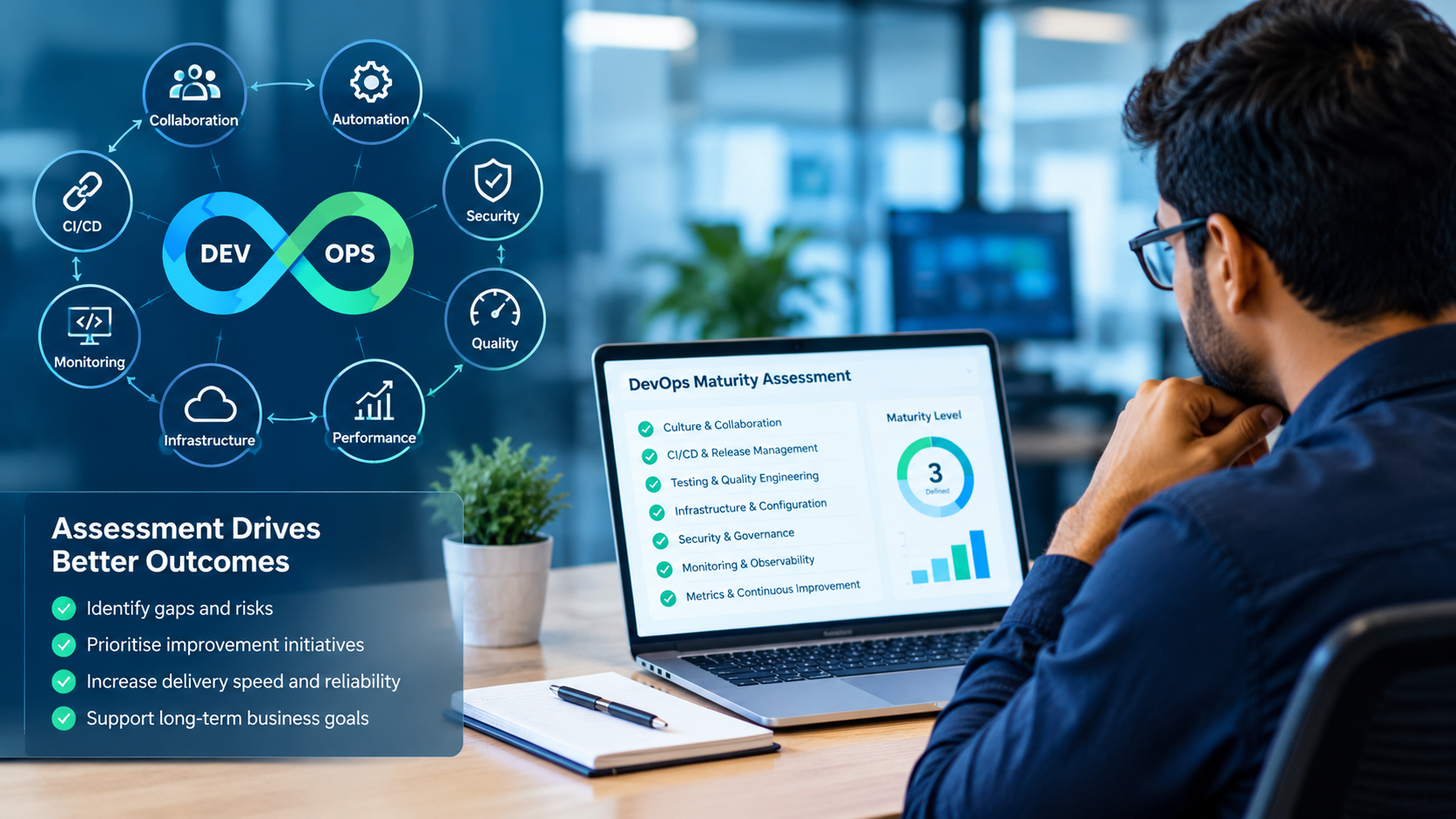
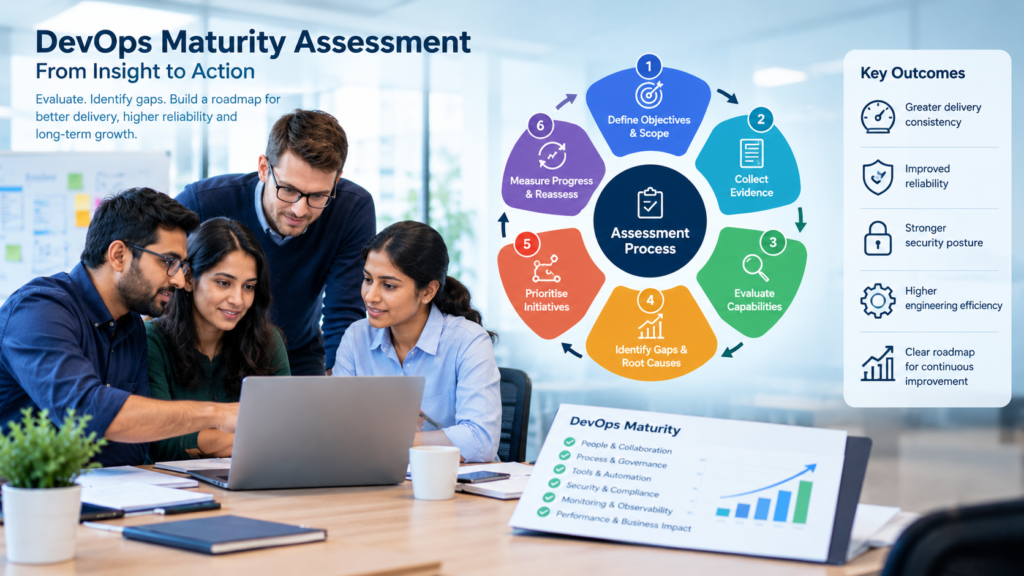
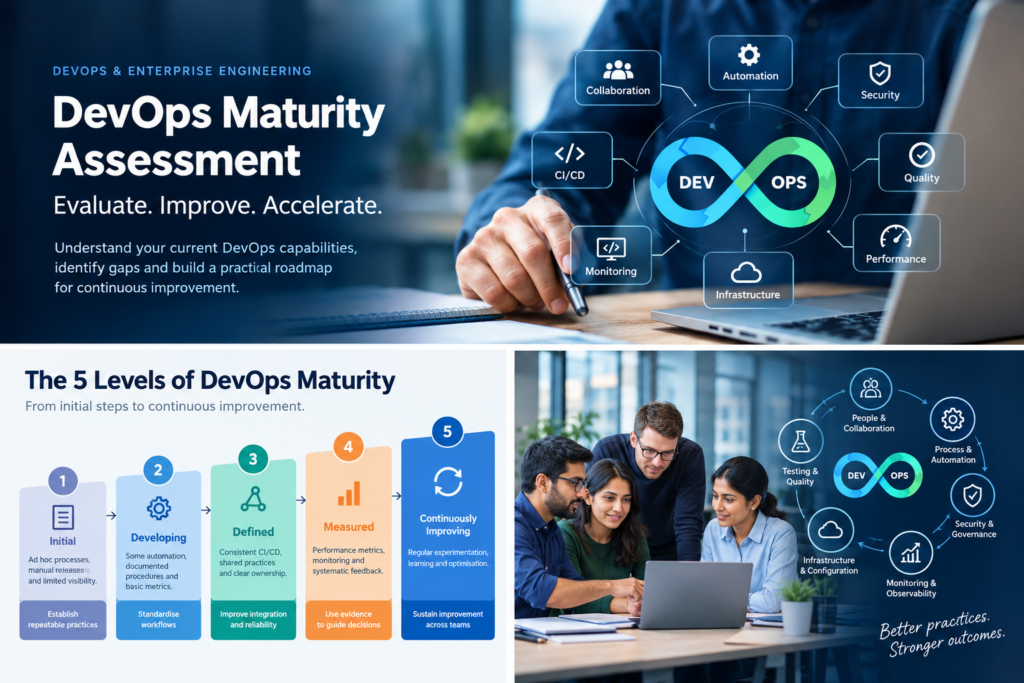
To provide structural direction for enterprise cloud transformations, Sandhata applies the DevOps & SRE Maturity Compass—a detailed diagnostic framework evaluating cloud delivery practices across 30 to 40 measurement criteria.
Level 1: Manual Cloud Management. Cloud infrastructure is provisioned through manual cloud portals. Environment drift is widespread, release pipelines are ad-hoc, and cloud cost management is absent.
Level 2: Basic Scripting and Ad-hoc Automation. Infrastructure scripts are utilized for basic server deployments, but lack version control. CI/CD pipelines automate code compilation, but environmental configurations and security testing remain manual.
Level 3: Automated Cloud Pipelines. Infrastructure as Code is standardized across development teams. CI/CD pipelines incorporate automated security checks, unit tests, and automated cloud deployments. Cloud resource utilization is monitored continuously.
Level 4: Advanced Cloud Native Agility. Fully automated multi-cloud delivery pipelines operate with integrated Policy as Code governance. Ephemeral environments handle feature testing, self-healing container platforms support high availability, and cloud cost optimization runs automatically.
The Maturity Compass offers enterprise decision-makers a clear baseline assessment, uncovers operational risks, and outlines a targeted roadmap for achieving enterprise cloud maturity.
Section 4: Enterprise Impact – Real-World Cloud DevOps Case Studies
Case Study 1: Global Investment Bank Multi-Cloud Pipeline Standardization
A major investment bank operated fragmented software development teams across three distinct cloud environments and on-premises data centers. Legacy manual security controls and inconsistent deployment pipelines caused software release cycles to stretch over 12 weeks, severely delaying new feature introductions.
Sandhata deployed a dedicated team of Cloud DevOps Engineers to design a unified, multi-cloud automated delivery framework. The team established standardized Infrastructure as Code modules, created automated DevSecOps security scanning gates, and implemented policy-as-code validation routines.
The result was a transformed delivery pipeline: application deployment lead time dropped by 80%, decreasing from 12 weeks to under 48 hours. Automated security validation eliminated pre-release audit bottlenecks while ensuring total compliance with international financial regulations.
Case Study 2: Major Telecom Provider Cloud Native Containerization
A global telecommunications provider struggled to scale its online customer management portal during high-demand network events. The monolithic architecture was hosted on legacy virtual machine infrastructure, requiring expensive static compute capacity and manual scaling interventions.
Sandhata engineered a comprehensive cloud modernization initiative, converting the monolithic application into containerized microservices managed on cloud Kubernetes clusters. Sandhata implemented automated CI/CD pipelines featuring ephemeral testing environments and automated canary deployment strategies.
The solution delivered dynamic autoscaling capabilities that seamlessly handled 300% spikes in subscriber traffic without manual intervention. Cloud infrastructure operational costs dropped by 42% through efficient resource utilization, and change failure rates fell below 1%.
Section 5: Essential Metrics for Cloud DevOps Success
Measuring the business impact of a Cloud DevOps transformation requires tracking clear performance indicators. Sandhata focuses on delivering measurable improvements across key operational metrics:
Deployment Frequency: How frequently production code deployments occur. Cloud DevOps automation increases release cadences from quarterly batches to multiple daily deployments.
Lead Time for Changes: The duration required for a committed code change to successfully deploy to production. Modern cloud engineering targets lead times measured in hours or minutes rather than weeks.
Mean Time to Restore (MTTR): The speed at which systems recover from unexpected operational degradation. Automated cloud infrastructure rebuilds and self-healing orchestration drastically reduce recovery times.
Change Failure Rate: The percentage of production deployments requiring emergency hotfixes or rollbacks. Automated pipeline validation and policy checks maintain change failure rates under 2%.
Cloud Infrastructure Cost Efficiency: Measuring cloud compute utilization efficiencies achieved by eliminating orphaned resources and leveraging dynamically scaled ephemeral environments.
Section 6: Frequently Asked Questions (FAQs)
FAQ 1: What are Cloud DevOps Engineering Services?
Cloud DevOps Engineering Services combine cloud infrastructure automation, modern DevOps continuous delivery practices, Infrastructure as Code, and automated security policies to help enterprise organizations build, scale, and manage workloads in public, private, and hybrid cloud environments efficiently.
FAQ 2: How does Sandhata accelerate cloud migration for regulated enterprise organizations?
Sandhata accelerates enterprise cloud migration through automated Infrastructure as Code templates, automated security compliance gates, and Service Virtualization. This ensures legacy applications and mainframes can seamlessly communicate with modern cloud components without risk or downtime.
FAQ 3: What role does Infrastructure as Code play in Cloud DevOps Engineering Services?
Infrastructure as Code allows operations and engineering teams to define cloud networks, servers, databases, and security configurations using declarative code files. This eliminates manual configuration drift, enables rapid deployment of ephemeral testing environments, and guarantees full environment repeatability.
FAQ 4: How do Cloud DevOps Engineering Services improve enterprise software release speed?
Cloud DevOps automation eliminates manual provisioning bottlenecks and approval delays. By automating building, testing, code security scanning, and infrastructure provisioning within unified CI/CD pipelines, release cycles shorten from months to hours.
FAQ 5: How is security embedded into Cloud DevOps Engineering workflows?
Security is integrated directly into software pipelines through DevSecOps automation. This includes automated static application security testing, container image scanning, secret detection, dynamic security analysis, and Policy as Code enforcement before any code deploys to production.
FAQ 6: Can Sandhata manage multi-cloud DevOps environments across AWS, Azure, and Google Cloud?
Yes. Sandhata specializes in multi-cloud engineering, constructing standardized pipeline frameworks and infrastructure abstractions that enable seamless software deployments across Amazon Web Services, Microsoft Azure, Google Cloud Platform, and private cloud systems.
FAQ 7: What is the difference between Cloud Engineering and Cloud DevOps Engineering?
Cloud Engineering focuses on architecture design, cloud resource provisioning, and cloud networking. Cloud DevOps Engineering extends this by introducing continuous automation, CI/CD pipelines, automated testing, automated security governance, and self-healing operational workflows.
FAQ 8: How does Cloud DevOps support hybrid architectures containing legacy mainframes?
Sandhata connects modern cloud microservices with legacy mainframes using API gateways, automated interface testing, and Service Virtualization. This allows cloud applications to develop rapidly while relying on secure, automated integrations with legacy backends.
FAQ 9: How do Cloud DevOps Engineering Services lower overall cloud infrastructure costs?
Cloud DevOps practices reduce cost through automated resource scaling, dynamic provisioning of temporary environments that dismantle when testing completes, identification of unused resources, and optimized cloud architectural patterns.
FAQ 10: What is Policy as Code in Cloud DevOps governance?
Policy as Code defines security policies, compliance rules, and resource standards in code files. Automated tools evaluate infrastructure scripts against these policies during pipeline execution, blocking non-compliant setups before deployment.
FAQ 11: How does Sandhata evaluate an enterprise’s current cloud DevOps readiness?
Sandhata uses the proprietary DevOps & SRE Maturity Compass to audit enterprise delivery workflows across 30 to 40 measurement dimensions, identifying friction points, security risks, and delivery bottlenecks to establish an actionable modernization plan.
FAQ 12: What are ephemeral environments and why are they important in Cloud DevOps?
Ephemeral environments are temporary cloud staging testing environments spun up automatically on demand for specific feature tests or pull requests. Once testing completes, the environment terminates automatically, reducing cloud costs and eliminating configuration drift.
FAQ 13: How does Cloud DevOps ensure regulatory compliance in banking and telecommunications?
By enforcing automated audit logging, immutable infrastructure builds, automated compliance verification checks, and strict separation of duties within CI/CD pipelines, Cloud DevOps guarantees continuous compliance with regulations such as DORA, PRA rules, and PCI-DSS.
FAQ 14: What container technologies are utilized in Cloud DevOps engineering engagements?
Sandhata implements containerization utilizing Docker alongside Kubernetes orchestration platforms such as Amazon EKS, Azure AKS, Google GKE, and Red Hat OpenShift to build portable, scalable enterprise workloads.
FAQ 15: How long does an enterprise Cloud DevOps transformation engagement take with Sandhata?
Initial maturity audits and baseline architectural designs take 2 to 4 weeks. High-impact automated pipelines, Infrastructure as Code foundations, and pilot team migrations typically complete within 8 to 12 weeks.
Strategic Recommendation and Next Steps
Building a successful enterprise cloud operation requires more than simply migrating server workloads to third-party data centers; it demands a fundamental modern engineering transformation. Without automated continuous delivery pipelines, automated governance, and declarative infrastructure, cloud environments quickly become complex, costly, and fragile.
Sandhata Technologies provides the deep engineering expertise required to turn modern cloud environments into sustainable competitive advantages. Backed by over two decades of enterprise engineering excellence across highly regulated markets, Sandhata helps organizations modernize their cloud foundations with confidence.
Contact Sandhata’s Cloud DevOps Engineering Specialists today to schedule your DevOps & SRE Maturity Compass Assessment and start building your modern enterprise cloud platform.