Table of Contents
EV Charger Repair Company Hyderabad (2026): DC Fast & AC Maintenance
The rapid expansion of electric mobility across Telangana has transformed Hyderabad into a major hub for public, workplace, fleet, and residential charging infrastructure. Dense commercial corridors like HITEC City, Gachibowli, Nanakramguda, and Madhapur, alongside high-traffic residential nodes in Kondapur, Tellapur, Miyapur, and Begumpet, depend on high-uptime Electric Vehicle Supply Equipment (EVSE). However, heavy daily utilization, summer ambient heat spikes exceeding 42°C, grid voltage fluctuations, and monsoon humidity lead to hardware breakdowns, component wear, and software failures.
Partnering with a specialized EV charger repair company in Hyderabad is a vital operational safeguard for Charge Point Operators (CPOs), fleet directors, IT park facility managers, and commercial site hosts. Beyond routine electrical work, professional EVSE repair requires high-voltage power electronics engineering, silicon carbide (SiC) module restoration, digital communication protocol debugging (OCPP 1.6J/2.0.1/2.1 over WebSockets), and strict compliance with TGSPDCL (Telangana State Southern Power Distribution Company Limited) grid earthing standards.
This comprehensive technical guide details failure modes, component-level diagnostic procedures, field repair SLAs, preventative maintenance routines, and regulatory safety compliance across Greater Hyderabad.
1. Core Scope of Work: What an Enterprise EV Charger Repair Company Delivers
An enterprise EV charger repair company in Hyderabad provides 24/7 corrective, preventative, and predictive engineering services for residential wallboxes, commercial AC chargers, and high-power DC fast-charging stations.
Rather than simply swapping out entire expensive cabinets, specialized repair companies perform component-level diagnostic isolate-and-repair operations across four primary subsystem layers:
Phase 1: High-Voltage Electrical & Power Conversion Layer
- AC/DC Rectifier & SiC MOSFET Repair: Diagnosing and replacing blown Silicon Carbide (SiC) MOSFET switching modules, IGBT gate drivers, and high-voltage DC-DC converters in 30 kW to 240 kW fast chargers.
- Switchgear & Protection Devices: Replacing welded AC/DC contactors, tripped Miniature Circuit Breakers (MCBs), blown semiconductor fuses, and degraded Type-2 Surge Protection Devices (SPDs).
- Transformer & Input Power Fixing: Resolving phase imbalances, neutral-to-earth voltage leaks, and thermal degradation inside dedicated K-factor step-down transformers.
Phase 2: Cable, Connector, and Thermal Management Subsystems
- Liquid-Cooling System Maintenance: Diagnosing coolant pump failures, clearing fluid line blockages, topping up synthetic glycol mixtures, and replacing worn seals in 120 kW+ Ultra-Fast High-Power Chargers (HPC).
- Connector Pin & Handle Replacement: Replacing oxidized, bent, or thermally damaged CCS2, Type 2, or LECCS connector pins, damaged latch mechanisms, and worn cable jackets.
- Internal Air Flow & Filter Cleaning: Replacing clogged air intake filters, failed IP54/IP65 ventilation fans, and repairing internal temperature sensors (PT100/NTC thermistors).
Phase 3: Control Hardware & Embedded Telemetry
- Main Microcontroller & Communications Board Repair: Refurbishing or replacing main Linux/RTOS embedded controller boards, cellular 4G/5G M2M modems, and RS485/CAN-bus interface modules.
- Ground Leakage & Insulation Monitoring: Calibration and replacement of active Insulation Monitoring Devices (IMDs) and Type-B Residual Current Devices (RCDs) that trigger false ground-fault trips.
- HMI Touchscreen & POS Payment Terminals: Repairing water-damaged or sun-faded LCD/LED touchscreens, RFID card readers, and embedded UPI payment terminals.
Phase 4: Software, Firmware & OCPP Network Recovery
- OCPP Protocol Debugging: Resolving persistent WebSocket connection drops, authentication handshake failures, and meter values payload corruptions over OCPP 1.6J and 2.0.1/2.1.
- Over-the-Air (OTA) Recovery: Flashing corrupt controller memory boards via direct JTAG/USB ports when remote OTA firmware updates fail or soft-lock the hardware.
- Dynamic Load Management (DLM) Tuning: Re-calibrating Current Transformers (CTs) and cloud load-balancing logic to prevent facility breaker trips.
2. Common EVSE Failure Modes in Greater Hyderabad
Hyderabad’s unique climate and operational parameters create distinct failure modes across different charger topologies:
Failure Mode 1: Thermal Throttling & High-Temperature Shutdowns
- Root Cause: During peak summer months (April to June), ambient temperatures in outdoor parking lots across HITEC City and Gachibowli frequently exceed 42°C. Inadequate shaded canopies, coupled with clogged dust filters or degraded liquid cooling pumps, push internal cabinet temperatures beyond 85°C.
- Symptom: The charger automatically throttles output current from 150A down to 30A or triggers a thermal emergency shutdown mid-session.
- Repair Solution: Deep cabinet cleaning, high-CFM fan replacement, coolant loop pressure flushing, and installing external thermal radiation shields.
Failure Mode 2: High Neutral-to-Earth Voltage & Ground-Fault Trips
- Root Cause: Heavy monsoon rains (July to October) cause moisture ingress into underground cable trenches and earthing pits. Inadequate earthing chemical compound leads to earth pit resistance spiking above 1 Ohm, causing Neutral-to-Earth voltage to exceed 5V AC.
- Symptom: The charger’s internal Insulation Monitoring Device (IMD) flags a critical ground fault and blocks charge session initiation.
- Repair Solution: Sinking fresh chemical earthing pits using copper-bonded steel electrodes, re-treating bentonite soil layers, resealing cable entry glands to IP65/IP66 standards, and replacing degraded RCD Type-B breakers.
Failure Mode 3: Contactor Welding & AC/DC Latch Failures
- Root Cause: Frequent utility grid power fluctuations, sudden load sheds, or repeated emergency stop button activations under full $150\text{A}+$ load cause severe electrical arcing across internal contactor plates.
- Symptom: Contactor contacts weld together in a closed state, preventing high-voltage disconnection and locking the charging handle inside the vehicle inlet.
- Repair Solution: Safely discharging high-voltage DC bus capacitors, replacing welded heavy-duty contactors, and installing arc suppression snubbers.
Failure Mode 4: OCPP WebSocket Telemetry Lockups
- Root Cause: Intermittent cellular coverage drops or SIM card register drops in deep basement parking garages across Cyberabad result in buffer overflows inside legacy OCPP 1.6J microcontrollers.
- Symptom: The charger appears “Offline” on driver mobile apps and public maps, rejecting RFID cards or UPI payments despite physical power being active.
- Repair Solution: Upgrading 4G M2M modems with high-gain external antenna extensions, clearing EEPROM flash memory locks, updating firmware to OCPP 2.0.1 with local offline transaction caching, and re-establishing secure TLS 1.3 WebSockets.
3. Specifications Matrix: EVSE Diagnostics Across Hyderabad Site Types
Selecting the correct field repair approach depends directly on charger architecture and deployment context:
4. Emergency Field Response SLAs and Preventative Maintenance Schedules
To maintain network uptime above 99%, enterprise repair companies structure operations into defined Service Level Agreements (SLAs) and preventative maintenance schedules:
Service Level Agreement (SLA) Tiers for Greater Hyderabad
- Tier 1 Critical Response (Public Fast Chargers & Fleet Depots):
- On-Site Technician Arrival: Within 2 Hours (Cyberabad / Core IT Corridor) or 4 Hours (Outer Ring Road / Suburbs).
- Diagnostic Resolution Target: Within 4 Hours of dispatch.
- Hardware Swap Target: Within 12 Hours if major SiC power modules or transformers require replacement.
- Tier 2 Standard Response (Workplaces & Retail Destinations):
- On-Site Technician Arrival: Within 6 Hours of logging an incident ticket.
- Diagnostic Resolution Target: Within 8 Hours of arrival.
- Tier 3 Residential & Private Community Response:
- On-Site Technician Arrival: Within 24 Hours.
- Diagnostic Resolution Target: Same-day resolution upon site access.
Preventative Maintenance (PM) Lifecycle Schedule
- Monthly Operations Check:
- Visual inspection of cable jackets, connector pins, and emergency stop button mechanics.
- Clearing dust filters and inspecting IP54/IP65 rubber door seals.
- Verification of cellular RSSI signal levels and OCPP heartbeat latency.
- Quarterly Electrical & Thermal Audit:
- Infrared thermal imaging of all terminal blocks, switchgear busbars, and contactor joints under continuous $100\text{A}+$ load.
- Measuring earth pit resistance using a 3-point fall-of-potential earth tester (verifying $< 1\text{ Ohm}$).
- Testing Type-B RCD trip currents and millisecond response speeds.
- Bi-Annual Deep Maintenance:
- Testing coolant fluid dielectric strength, operating pressure, and top-ups in liquid-cooled HPC dispensers.
- Insulation resistance testing (Megohmmeter test at 1000V DC) across phase-to-phase, phase-to-neutral, and phase-to-earth lines.
- Full calibration of billing energy meters against secondary certified reference meters.
5. Cost Analysis & Repair Estimates for Hyderabad
The financial cost of EV charger repair in Hyderabad varies depending on whether a site host operates under an Active Maintenance SLA, Pay-per-Call Field Dispatch, or Component Refurbishment:
| Component / Service Type | Service Description | Typical Labor & Diagnostic Cost | Typical Spare Part Cost | Total Turnkey Cost Estimate |
| Diagnostic On-Site Visit | Initial physical inspection, thermal scan, IMD insulation test, error code log pull | ₹500 – ₹1,500 | ₹0 | ₹500 – ₹1,500 (Waived if repair approved) |
| CCS2 / Type 2 Cable Replacement | Swapping thermally damaged or cut charging cable assembly with new 5m 150A handle | ₹1,500 – ₹3,000 | ₹18,000 – ₹35,000 | ₹19,500 – ₹38,000 |
| SiC Power Module Replacement | Replacing blown 15 kW / 20 kW / 30 kW AC-to-DC converter module in DC fast charger | ₹3,500 – ₹7,000 | ₹45,000 – ₹95,000 | ₹48,500 – ₹1,02,000 |
| Contactor & Switchgear Overhaul | Replacing arc-welded 3-phase AC/DC contactor, MCB breaker, and Type-2 SPD | ₹2,000 – ₹4,000 | ₹8,500 – ₹18,000 | ₹10,500 – ₹22,00,000 |
| Chemical Earthing Pit Treatment | Sinking a fresh chemical earth pit, adding conductive bentonite compound, and running copper tape | ₹2,500 – ₹4,500 | ₹6,000 – ₹11,000 | ₹8,500 – ₹15,500 |
| Main Control Board / Modem Fix | Refurbishing Linux MCU board, updating firmware, and replacing 4G M2M modem assembly | ₹2,000 – ₹4,000 | ₹12,000 – ₹24,000 | ₹14,000 – ₹28,000 |
6. Step-by-Step Field Repair Workflow
A certified EV charger repair company in Hyderabad executes a structured 5-step engineering process for every field repair call:
- Step 1: Telemetry Analysis & Remote Triage System engineers extract live error logs, telemetry values, and OCPP diagnostic codes (e.g.,
GroundFailure,HighTemperature,OverCurrent,InternalError) via the cloud CPMS backend. If the error is a software soft-lock, a remote hard reset is attempted over WebSockets. - Step 2: On-Site Safety Isolation & LOTO Procedure Upon arrival, the field engineer isolates high-voltage AC inputs at the primary LT distribution breaker and applies physical Lockout/Tagout (LOTO) locks. High-voltage DC bus capacitors are verified to have discharged safely ($< 50\text{V}$ DC) using a calibrated 1000V multimeter before cabinet doors are opened.
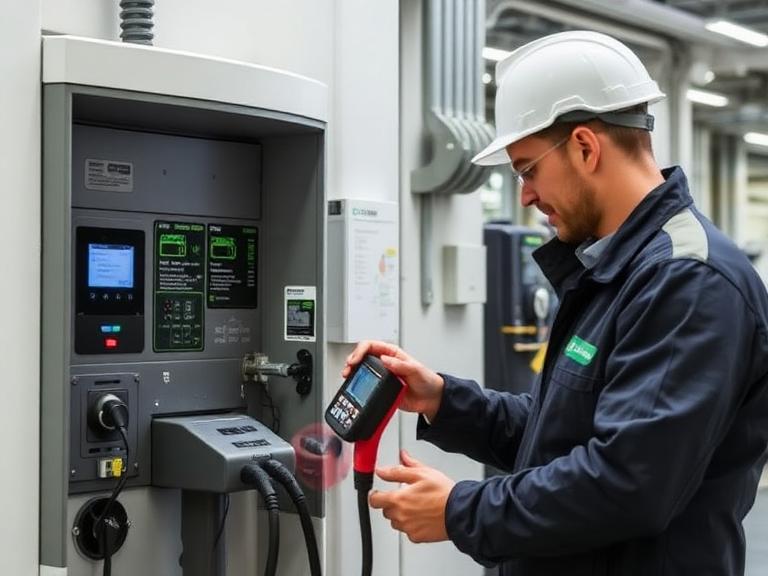
- Step 3: Component Isolation & Diagnostic Testing Using specialized diagnostic tools—including micro-ohmmeters for pin resistance, curve tracers for SiC MOSFET integrity, and Megohmmeters for insulation testing—the technician isolates the precise root cause without damaging adjacent logic boards.
- Step 4: Physical Component Swap & Chemical Re-Treatment The damaged sub-assembly (e.g., contactor, IMD sensor, cable handle, or power module) is replaced with an OEM-certified component. If earthing degradation triggered the fault, chemical earth pits are re-treated with conductive compounds to bring resistance back under 1 Ohm.
- Step 5: High-Power Live Testing & CEIG Re-Certification The station is re-energized. A full simulated test is conducted using a diagnostic EV test bench or live vehicle to verify pilot signal (CP) pulse-width modulation, insulation resistance during power transfer, thermal stability at maximum amperage, and automated payment clearing.
Frequently Asked Questions (15 Detailed FAQs)
Q1: Why is my EV charger showing a ground fault error in Hyderabad?
Ground fault errors typically occur during Hyderabad’s heavy monsoon season when water enters underground cable trenches or when chemical earthing pits dry out during intense summer heat spikes, raising earth pit resistance above 1 Ohm. A specialized repair company treats the earth pit with conductive compounds and reseals cable glands.
Q2: What causes an EV charger handle to lock into a car and fail to release?
Connector lock issues occur due to mechanical solenoid actuator failure inside the handle assembly, or when severe electrical arcing welds contactor plates together, preventing the internal controller from confirming a zero-current safety state before unlatching.
Q3: How quickly can a field technician respond to a DC fast charger breakdown in HITEC City?
Under an enterprise Tier-1 SLA contract, certified repair technicians arrive on-site within 2 Hours across Cyberabad, HITEC City, Gachibowli, and Nanakramguda, carrying replacement contactors, cables, and diagnostic tools.
Q4: Can a repair company fix an EV charger that appears offline on mobile apps?
Yes. Technicians resolve offline issues by diagnosing 4G/5G M2M cellular modems, installing high-gain external antenna extensions for basement installations, clearing memory buffer locks, or updating OCPP 2.0.1 WebSocket connection scripts.
Q5: How much does a site visit for EV charger diagnostics cost in Hyderabad?
A standard diagnostic site visit costs ₹500 to ₹1,500 depending on site location and charger capacity. Most enterprise repair companies waive this diagnostic fee from the final invoice if the site host approves the repair quote.
ev.care+ 1
Q6: What causes thermal throttling in DC fast chargers during Hyderabad summers?
Thermal throttling occurs when ambient temperatures exceed 40°C, combined with clogged cabinet air intake filters, failed internal cooling fans, or low liquid coolant levels in 120 kW+ chargers, forcing the system to throttle output current to protect sensitive electronics.
Q7: Are spare parts readily available for major EV charger brands in Hyderabad?
Leading repair companies maintain local warehouse inventory in Hyderabad for critical universal components—including CCS2 cables, Type 2 handles, 3-phase AC contactors, Type-B RCDs, Type-2 SPDs, 12V auxiliary power supplies, and standard SiC rectifier modules.
Q8: Do EV charger repair companies handle TGSPDCL electrical compliance issues?
Yes. Specialized repair firms resolve neutral-to-earth voltage leaks, correct transformer phase imbalances, upgrade sub-panel circuit breakers, and re-certify chemical earthing pits to satisfy TGSPDCL and CEIG safety standards.
Q9: What is the difference between repairing an AC wallbox and a DC fast charger?
AC wallbox repairs focus primarily on RCD breakers, contactors, Control Pilot (CP) signaling boards, and RFID card readers. DC fast charger repairs involve high-voltage AC-to-DC SiC power modules, IMD sensors, liquid cooling loops, and complex CAN-bus protocols.
Q10: How do repair companies fix damaged CCS2 or Type 2 connector pins?
Technicians evaluate pin oxidation and contact resistance using micro-ohmmeters. If damage is localized, individual silver-plated copper pin inserts are replaced; if thermal melting has occurred, the complete cable and handle assembly is swapped.
Q11: Can an out-of-warranty EV charger be repaired instead of replaced?
Yes. Component-level repair (swapping individual rectifiers, relays, IMD sensors, or modems) costs 70% to 85% less than replacing an entire commercial charger cabinet, extending asset operational life significantly.
Q12: Why does my EV charger trip the main building circuit breaker upon plugging in?
This usually points to a short circuit inside a main SiC power module, a shorted isolation transformer, moisture ingress inside the connector handle, or an undersized MCB breaker incapable of handling initial inrush currents.
Q13: What maintenance is required for liquid-cooled EV charging cables?
Liquid-cooled systems require bi-annual coolant pressure testing, checking glycol fluid dielectric strength, replacing filter cartridges, inspecting radiator fans, and checking hose seals.
Q14: Do repair companies offer Annual Maintenance Contracts (AMCs)?
Yes. Enterprise CPOs and commercial property managers can sign comprehensive AMCs that cover 24/7 telemetry monitoring, scheduled preventative maintenance visits, guaranteed SLA response times, and spare parts replacement.
Q15: What safety procedures are followed during high-voltage EV charger repairs?
Engineers enforce Lockout/Tagout (LOTO) procedures on main feeder breakers, wear 1000V-rated NFPA 70E arc-flash PPE, discharge internal high-voltage DC bus capacitors (<50V), and test for zero voltage before touching internal components.
Enterprise Repair Partner Selection Checklist
Partnering with a specialized EV charger repair company in Hyderabad bridges high-voltage power engineering with cloud software diagnostics. By enforcing strict preventative maintenance, securing rapid SLA response times, rectifying TGSPDCL earthing issues, and performing component-level repairs, Charge Point Operators and facility managers maintain reliable, high-uptime charging assets across Greater Hyderabad.